



HiBiTタグ付きタンパク質の高感度・高特異性定量を、従来のウェスタンブロットよりも迅速かつ再現性高く行うシンプルウェスタンの技術評価をご紹介します。
<技術の特徴>
•HiBiTタグ:Promega社が提供している 11アミノ酸の小型タグ。LgBiTと結合して強いルシフェラーゼ活性を発揮。
•シンプルウェスタン(Simple Western™):キャピラリーベースの自動化免疫測定技術。分離・検出・定量を一括処理。
<主な利点>
•最大96サンプルを約3時間で処理可能。
•分子量分解能により、アイソフォームや分解産物の識別が可能。
•従来法よりも高感度(LOD: Jess 0.11 ng/mL、Leo 0.24 ng/mL、WB 0.66 ng/mL)。
•広い定量範囲(0.32–5,000 ng/mL)と高い再現性(R² > 0.99)。
<応用例>
BRD4のターゲット分解
•A549細胞にHiBiTタグを付加したBRD4を用い、PROTAC化合物(Compound 8)による分解を評価。
•HiBiT、BRD4 N末端、C末端抗体で同様の分解傾向を確認。
•DC₅₀およびDₘₐₓの定量により、分解効率を高精度に評価。
<結論>
Simple Westernは、HiBiTタグ付きタンパク質の定量において、従来法よりも高感度・高再現性・高スループットを実現。TPD研究やアイソフォーム解析において、プレートベースアッセイの補完技術として有用。
このカタログについて
| ドキュメント名 | HiBiTタグとシンプルウェスタンによる、高精度なタンパク質定量 |
|---|---|
| ドキュメント種別 | 事例紹介 |
| ファイルサイズ | 720.9Kb |
| 登録カテゴリ | |
| 取り扱い企業 | プロテインシンプルジャパン株式会社 (この企業の取り扱いカタログ一覧) |
この企業の関連カタログ



このカタログの内容
Page1
Application Note
Simple Western HiBiT Assay
Highly Specific Protein Quantification
Using an Anti-HiBiT Monoclonal Antibody
and Simple Western Technology
Automated Analysis of HiBiT-Protein Expression, Isoforms,
Targeted Protein Degradation, and More
Introduction
Accurate quantification of tagged proteins plays a pivotal determination to characterize hits identified via
role in a broad array of biological applications, including HiBiT plate screens.
protein expression profiling, isoform characterization,
assay validation, and targeted protein degradation (TPD) Key Takeaways:
studies. The HiBiT protein tagging system, developed by • High-throughput, high-specificity antibody-based
Promega, provides a sensitive and versatile method for detection of HiBiT-tagged proteins, offering a powerful
protein detection through an 11–amino acid peptide tag. orthogonal approach to plate-based luminescent
The HiBiT tag binds to its complementary subunit LgBiT HiBiT assays.
to reconstitute NanoBiT® luciferase, a bright, luminescent
enzyme, enabling rapid protein quantification in multiple • Capable of processing up to 96 samples in ~3 hours,
formats, including lytic and live-cell plate-based assays. combining throughput with molecular weight resolution,
A high-affinity anti-HiBiT monoclonal antibody expands ideal for efficient screening follow-up or standalone
the utility of the HiBiT-tag, enabling traditional epitope tag protein analysis
analysis of HiBiT-tagged proteins.
• Demonstrated sensitivity exceeding traditional Western
While plate-based HiBiT assays are fast and high- blot and broad dynamic and linear ranges
throughput, they lack the molecular-weight resolution
required to verify tagged-protein identity and to • Quantitative DC₅₀ and Dmax characterization of
distinguish isoforms or degradation products. degradation hits identified in HiBiT screens, providing
Simple Western™ Technology addresses this gap with enhanced resolution and isoform specificity
automated capillary-based immunoassays that integrate HiBiT CP Total Protein
protein separation, immunoprobing, and detection on a 16 30
single platform. Compared with traditional western blots, 14 25
Simple Western offers markedly higher sensitivity along 12
with excellent reproducibility, total-protein normalization, 20
10
and multiplexing capabilities, making it an effective
8 15
orthogonal complement to plate-based assays.
6
10
In this application note, we evaluate the performance of 4
the Anti-HiBiT Monoclonal Antibody from Promega using 5
2
Simple Western Technology (Fig. 1). Simple Western
assays that utilize Anti-HiBiT Monoclonal Antibody 0 0
12 40 66 116 180 230
provide an advanced solution for validating hits from MW (kDa)
high-throughput plate-based HiBiT screens. This study
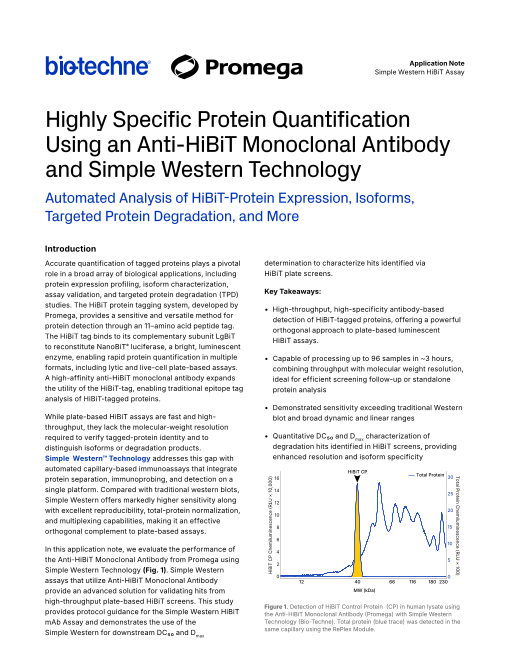
Figure 1. Detection of HiBiT Control Protein (CP) in human lysate using
provides protocol guidance for the Simple Western HiBiT the Anti-HiBiT Monoclonal Antibody (Promega) with Simple Western
mAb Assay and demonstrates the use of the Technology (Bio-Techne). Total protein (blue trace) was detected in the
Simple Western for downstream DC₅₀ and Dmax
same capillary using the RePlex Module.
HiBiT CP Chemiluminescence (RLU × 10,000)
Total Protein Chemiluminescence (RLU × 100)
Page2
Materials and Methods To optimize antibody performance, HiBiT Control Protein
Establishing the Simple Western HiBiT Assay (CP) was diluted to 10 ng/mL in 0.1 mg/mL human protein
extract to simulate complex biological samples. Samples
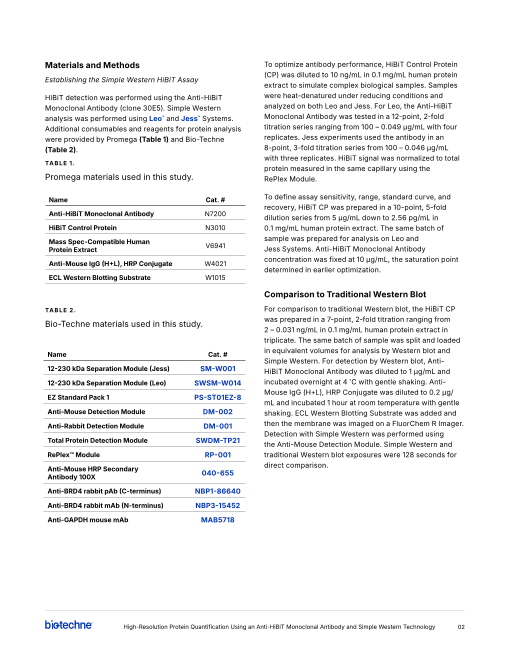
HiBiT detection was performed using the Anti-HiBiT were heat-denatured under reducing conditions and
Monoclonal Antibody (clone 30E5). Simple Western analyzed on both Leo and Jess. For Leo, the Anti-HiBiT
analysis was performed using Leo™ and Jess™ Systems. Monoclonal Antibody was tested in a 12-point, 2-fold
Additional consumables and reagents for protein analysis titration series ranging from 100 – 0.049 µg/mL with four
were provided by Promega (Table 1) and Bio-Techne replicates. Jess experiments used the antibody in an
(Table 2). 8-point, 3-fold titration series from 100 – 0.046 µg/mL
with three replicates. HiBiT signal was normalized to total
TA B L E 1 .
protein measured in the same capillary using the
Promega materials used in this study. RePlex Module.
Name Cat. # To define assay sensitivity, range, standard curve, and
recovery, HiBiT CP was prepared in a 10-point, 5-fold
Anti-HiBiT Monoclonal Antibody N7200 dilution series from 5 µg/mL down to 2.56 pg/mL in
HiBiT Control Protein N3010 0.1 mg/mL human protein extract. The same batch of
Mass Spec-Compatible Human sample was prepared for analysis on Leo and
Protein Extract V6941 Jess Systems. Anti-HiBiT Monoclonal Antibody
Anti-Mouse IgG (H+L), HRP Conjugate W4021 concentration was fixed at 10 µg/mL, the saturation point
determined in earlier optimization.
ECL Western Blotting Substrate W1015
Comparison to Traditional Western Blot
TA B L E 2 . For comparison to traditional Western blot, the HiBiT CP
Bio-Techne materials used in this study. was prepared in a 7-point, 2-fold titration ranging from
2 – 0.031 ng/mL in 0.1 mg/mL human protein extract in
triplicate. The same batch of sample was split and loaded
Name Cat. # in equivalent volumes for analysis by Western blot and
Simple Western. For detection by Western blot, Anti-
12-230 kDa Separation Module (Jess) SM-W001 HiBiT Monoclonal Antibody was diluted to 1 µg/mL and
12-230 kDa Separation Module (Leo) SWSM-W014 incubated overnight at 4 °C with gentle shaking. Anti-
Mouse IgG (H+L), HRP Conjugate was diluted to 0.2 µg/
EZ Standard Pack 1 PS-ST01EZ-8
mL and incubated 1 hour at room temperature with gentle
Anti-Mouse Detection Module DM-002 shaking. ECL Western Blotting Substrate was added and
Anti-Rabbit Detection Module DM-001 then the membrane was imaged on a FluorChem R Imager.
Detection with Simple Western was performed using
Total Protein Detection Module SWDM-TP21 the Anti-Mouse Detection Module. Simple Western and
RePlex™ Module RP-001 traditional Western blot exposures were 128 seconds for
Anti-Mouse HRP Secondary direct comparison.
Antibody 100X 040-655
Anti-BRD4 rabbit pAb (C-terminus) NBP1-86640
Anti-BRD4 rabbit mAb (N-terminus) NBP3-15452
Anti-GAPDH mouse mAb MAB5718
High-Resolution Protein Quantification Using an Anti-HiBiT Monoclonal Antibody and Simple Western Technology 02
Page3
BRD4 Targeted Protein Degradation BRD4, and C-terminal BRD4, respectively. Protein
A549 cells edited via CRISPR/Cas9 to insert the HiBiT tag expression measurements were normalized to GAPDH
at the N-terminus of the BRD4 gene were treated for detected in the same capillary using the RePlex Module
6 hours with vehicle only or treated with Compound 8, using mouse anti-GAPDH antibody prepared at
a BRD4-targeting PROTAC® Degrader, at concentrations 50 µg/mL concentration. Due to high (2 mg/mL) lysate
(nM) of 0.1, 0.5, 2, 4, 8, 32, and 125. Samples were concentration, Anti-Mouse HRP Secondary Antibody 100X
analyzed at concentrations (mg/mL) of 2.0, 0.5, and diluted to 1X was used for HiBiT detection, while the
0.1 for detection using antibodies targeting HiBiT, Anti-Mouse HRP Detection Module was used for BRD4
N-terminal BRD4, and C-terminal BRD4, respectively. (N- and C-term) and GAPDH detection. DC50 and Dmax
Primary antibodies were prepared at concentrations values were calculated using GraphPad Prism with a
(µg/mL) of 10, 40, and 20 targeting HiBiT, N-terminal 4-parameter logistic (4-PL), unweighted curve fit.
Results
Defining the Simple Western HiBiT Assay
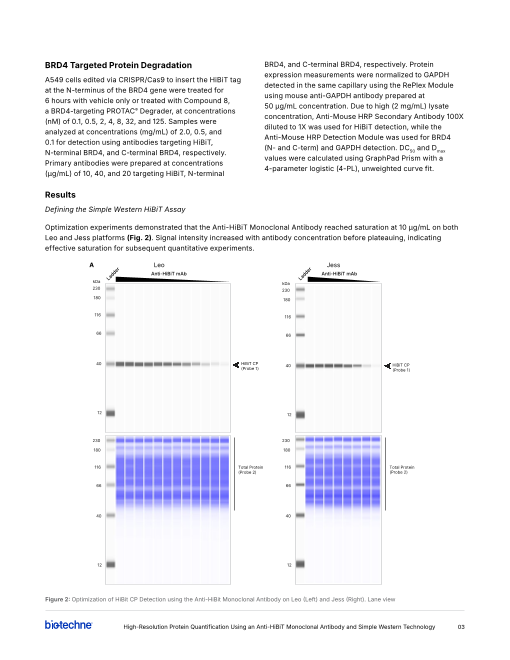
Optimization experiments demonstrated that the Anti-HiBiT Monoclonal Antibody reached saturation at 10 µg/mL on both
Leo and Jess platforms (Fig. 2). Signal intensity increased with antibody concentration before plateauing, indicating
effective saturation for subsequent quantitative experiments.
A r Leo
er Jess
adde Anti-HiBiT mAb add Anti-HiBiT mAb
kDa L L
kDa
230 230
180 180
116 116
66 66
40 HiBiT CP 40 HiBiT CP
(Probe 1) (Probe 1)
12 12
230 230
180 180
116 Total Protein 116 Total Protein
(Probe 2) (Probe 2)
66 66
40 40
12 12
Figure 2: Optimization of HiBit CP Detection using the Anti-HiBit Monoclonal Antibody on Leo (Left) and Jess (Right). Lane view
High-Resolution Protein Quantification Using an Anti-HiBiT Monoclonal Antibody and Simple Western Technology 03
Page4
B
5 Raw Area 20 Raw Area
Area Normalized to Total Protein Area Normalized to Total Protein
4
15
3
10
2
5
1
0 0
0.01 0.1 1 10 100 0.01 0.1 1 10 100
Anti-HiBiT mAb (μg/mL) Anti-HiBiT mAb (μg/mL)
Figure 2. Optimization of HiBiT CP detection using the Anti-HiBiT Monoclonal Antibody on Leo (left) and Jess (right). (A) Lane view of HiBiT detection
using the Anti-HiBiT Monoclonal Antibody and Total Protein Detection performed during the same run using the RePlex feature on Leo. (B) Antibody
saturation curves of average peak areas resulting from HiBiT detection using the Anti-HiBiT Monoclonal Antibody, including raw values (black trace)
and values normalized to total protein, shown in the blue trace and orange traces for Leo and Jess, respectively. Error bars represent standard
deviations from the means.
High-Resolution Protein Quantification Using an Anti-HiBiT Monoclonal Antibody and Simple Western Technology 04
HiBiT Peak Area × 10,000
HiBiT Peak Area × 10,000
Page5
The Simple Western HiBiT assay achieved a dynamic range exceeding four orders of magnitude (0.32 – 5000 ng/mL), with
a linear range of approximately 2.5 logs (0.32 – 200 ng/mL) (Fig. 3). This broad quantitative range allows for flexible assay
design across varied expression levels.
Dynamic Range
Leo Jess
9 14
8 12
7
10
6
5 8
4 6
3
4
2
1 2
0 0
0 1000 2000 3000 4000 5000 0 1000 2000 3000 4000 5000
HiBiT CP (ng/mL) HiBiT CP (ng/mL)
Linear Range
Leo Jess
14 35
12 30
10 R2 = 0.9993 25 R2 = 0.9938
8 20
6 15
4 10
2 5
0 0
0 50 100 150 200 0 50 100 150 200
HiBiT CP (ng/mL) HiBiT CP (ng/mL)
Figure 3. Dynamic and linear ranges of HiBiT detection using the Anti-HiBiT Monoclonal Antibody on Leo and Jess.
High-Resolution Protein Quantification Using an Anti-HiBiT Monoclonal Antibody and Simple Western Technology 05
Area x 100,000 Area x 1,000,000
Area x 100,000 Area x 1,000,000
Page6
Comparisons with traditional Western blot showed that both Leo and Jess were significantly more sensitive, detecting
HiBiT CP at concentrations as low as 0.1 ng/mL, compared to 0.5 ng/mL for traditional blotting (Fig. 4). Limit of detection
(LOD) values were 0.11 ng/mL for Jess and 0.24 ng/mL for Leo, compared to 0.66 ng/mL for Western blot (Table 3).
Similarly, limit of quantification (LOQ) values further underscored the improved sensitivity of Simple Western over
conventional methods (Table 3).
A Leo Jess B
HiBiT CP HiBiT CP (ng/mL) 7 HiBiT CP HiBiT CP (ng/mL) kDa
5 1.00 6 0.25 250
0.50 0.13
0.25 0.06 150
4 0.13 5 0.03
0.00 0.00 100
75
3 4
2 3 50
2 37
1 25
1 20
0 0 15
10
12 40 66 116 180230 12 40 66 116 180230 2.0 1.0 0.5 0.3
HiBiT CP
MW (kDa) MW (kDa) (ng/mL)
Figure 4. Sensitivity of HiBiT CP detection using the Anti-HiBiT Monoclonal Antibody by Simple Western Leo and Jess and traditional Western blot. (A)
Electropherograms of HiBiT CP Detection using Leo and Jess (B) traditional Western blot detection of HiBiT CP. The exposure for both Simple Western
and traditional Western blot was 128 seconds.
Parameter Leo Jess Western blot
LOD ng/mL (pg/well) 0.24 (0.72) 0.11 (0.33) 0.66 (1.98)
LOQ ng/mL (pg/well) 0.71 (2.13) 0.34 (1.02) 1.62 (4.86)
Table 3. LOD and LOQ of the HiBiT detection using the Anti-HiBiT Monoclonal Antibody on Leo and Jess and comparison to traditional Western blot.
High-Resolution Protein Quantification Using an Anti-HiBiT Monoclonal Antibody and Simple Western Technology 06
Chemiluminescence (RLU × 100)
Chemiluminescence (RLU × 100)
Page7
Standard curve analysis demonstrated strong assay reproducibility, with log-log nonlinear regression (1/y2 weighting)
yielding R2 values greater than 0.99 and recovery rates near 100% (Fig. 5). These data confirm that Simple Western can
reliably and quantitatively detect HiBiT-tagged proteins with high precision.
Standard Curve
Leo Jess
107 107
R2 = 0.9920 R2 = 0.9961
106 106
105 105
104 104
103 103
0.1 1 10 100 1000 0.1 1 10 100 1000
HiBiT CP (ng/mL) HiBiT CP (ng/mL)
% Recovery
Leo Jess
150 150
100 100
50 50
0 0
0.1 1 10 100 1000 0.1 1 10 100 1000
HiBiT CP (ng/mL) HiBiT CP (ng/mL)
Figure 5. Standard curve and recovery of HiBiT CP detection using the Anti-HiBiT Monoclonal Antibody on Leo and Jess.
High-Resolution Protein Quantification Using an Anti-HiBiT Monoclonal Antibody and Simple Western Technology 07
% Recovery Total Protein Normalized Area
% Recovery Total Protein Normalized Area
Page8
Utility of the Simple Western HiBiT Assay in Targeted Protein Degradation
To illustrate the assay’s relevance in targeted protein degradation workflows, we applied the method to monitor BRD4
degradation, a transcriptional co-activator implicated in cancer, in response to Compound 8, a next-generation PROTAC®
Degrader.1 A similar dose-dependent decrease in HiBiT-BRD4 signal in a breast cancer cell line (A549) was observed with
all three antibodies targeting HiBiT, N-terminal BRD4, and C-terminal BRD4 (Fig. 6). Importantly, Simple Western separates
full-length from truncated BRD4 isoforms, adding molecular-weight context that complements plate-based
luminescent readouts.
Leo
er
d Compound 8
La
d
kDa
230 BRD4 Long Isoform
180
BRD4 Short Isoforms
116
66
40
12
Anti-HiBiT Anti-BRD4 (N-term) Anti-BRD4 (C-term)
Jess
er
dd Compound 8
La
kDa
230 BRD4 Long Isoform
180
BRD4 Short Isoforms
116
66
40
12
Anti-HiBiT Anti-BRD4 (N-term) Anti-BRD4 (C-term)
Figure 6. BRD4 degradation by dosing with Compound 8 detected using the Anti-HiBiT Monoclonal Antibody and antibodies targeting N-terminal BRD4
and C-terminal BRD4. Cells were treated with Compound 8, a BRD4-targeting degrader, at concentrations of 0.1, 0.5, 2, 4, 8, 32, and 125 nM
(shown left to right).
High-Resolution Protein Quantification Using an Anti-HiBiT Monoclonal Antibody and Simple Western Technology 08
Page9
Dose-response curves derived from long BRD4 isoform
Anti-HiBiT
signals normalized to the vehicle-only control produced
nearly identical trends across detection strategies Anti-BRD4 (N-term)
100
(Fig. 7). Consistent DC Anti-BRD4 (C-term)
50 and Dmax values were obtained,
validating the Anti-HiBiT Monoclonal Antibody detection
method for characterizing BRD4 degradation (Fig. 8).
Together, these results demonstrate that HiBiT tagging
provides results consistent with traditional BRD4 antibody 50
detection, while Simple Western adds the ability to resolve
isoform-specific responses, offering deeper insight into
degrader-driven protein dynamics.
0
Ctrl 0.1 1 10 100 1000
Compound 8 (nM)
Figure 7. Dose-response analysis of BRD4 degradation by Compound
8 detected using 3 antibodies targeting HiBiT, N-terminal BRD4, and
C-terminal BRD4 normalized to the vehicle-only control.
Leo Jess
3.0 Raw DC50 120 Raw Dmax
2.60
2.43 100 96.1 95.6 95.5 96.5 98.1 95.6
2.0 80
1.57 1.59
1.39 1.41 60
1.0 40
20
0 0
HiBiT BRD4 (N-term) BRD4 (C-term) HiBiT BRD4 (N-term) BRD4 (C-term)
Antibody Target Antibody Target
Normalized DC50 120 Normalized Dmax
6 1.53 1.60
1. 96.2 96.3 94.8 96 97.8
100 .4 94.9
1.2 80
0.97
0.86 60
0.8 0.61
40
0.39
0.4
20
0 0
HiBiT BRD4 (N-term) BRD4 (C-term) HiBiT BRD4 (N-term) BRD4 (C-term)
Antibody Target Antibody Target
Figure 8. DC50 and Dmax values calculated from BRD4 degradation by Compound 8 detected using 3 antibodies targeting HiBiT, N-terminal BRD4, and
C-terminal BRD4 on Leo (blue bars) and Jess (orange bars). Values were normalized to GAPDH.
High-Resolution Protein Quantification Using an Anti-HiBiT Monoclonal Antibody and Simple Western Technology 09
Compound 8 DC50 (nM) Compound 8 DC50 (nM)
Dmax (%) Dmax (%)
% of Vehicle-only Ctrl
Page10
Conclusion R E F E R E N C E S
1. Actis M, Cresser-Brown J, Caine EA, et al. Evaluation of Cereblon-
Simple Western Technology provides a robust, highly Directing Warheads for the Development of Orally Bioavailable
specific platform for the quantitative detection of PROTACs. J Med Chem. 2025 Feb 13;68(3):3591-3611.
HiBiT-tagged proteins using the Anti-HiBiT Monoclonal 2. Prindle V, Richardson AE, Sher KR, et al. Synthetic lethality
Antibody from Promega. Simple Western provides of mRNA quality control complexes in cancer. Nature. 2025
molecular weight resolution to determine molecular Feb;638(8052):1095-1103.
weight variants and protein isoforms, complementing PROTAC® is a registered trademark of Arvinas Operations, Inc., and is
plate-based assays. Furthermore, Simple Western used under license.
provides superior sensitivity, reproducibility, and
automation compared to traditional Western blot
methods, supporting a wide dynamic range and enables
sub-picogram protein quantification. Its utility extends
from protein expression and isoform analysis to TPD
workflows, where accurate monitoring of degradation
kinetics is essential. The Anti-HiBiT Monoclonal
Antibody may also be used with Simple Western in
co-immunoprecipitation studies for identifying protein-
protein interactions.2
When paired with the Anti-HiBiT Monoclonal Antibody,
Simple Western becomes a valuable orthogonal tool
for confident characterization of tagged proteins in
both basic and translational research, offering a unified
workflow where Simple Western is directly integrated
into target screening using Promega’s Anti-HiBiT
Monoclonal Antibody, yielding higher specificity with up
to 96 samples analyzed in just 3 hours.
For research use or manufacturing purposes only. Trademarks and registered trademarks are the property of their respective owners.
18005539605_0925
Global Developer, Manufacturer, and Supplier of High-Quality Reagents, Analytical Instruments, and Precision Diagnostics.
INCLUDES R&D Systems™ Novus Biologicals™ Tocris Bioscience™ ProteinSimple™ Asuragen® ACD™ Lunaphore™