



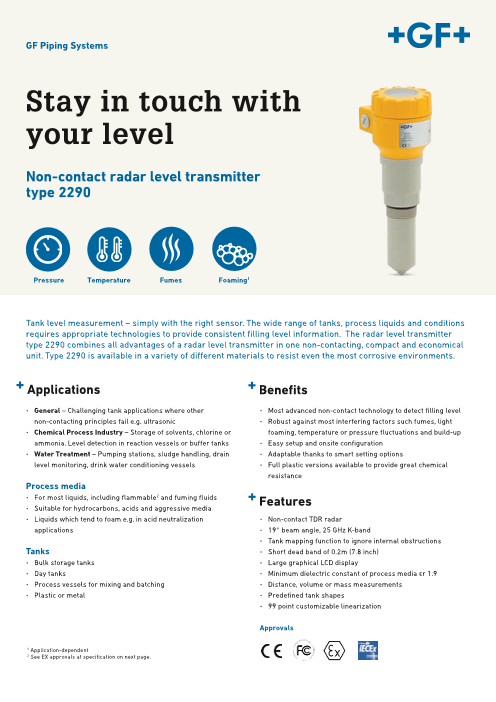
We have a solution to meet your application needs.
Depending on the application area, our customers have to face different
challenges in water treatment processes ranging from guaranteeing high water
qualities, to providing reliable measurements to assuring stringent regulations.
This is where GF products are positioned to accommodate the automation
market by o! ering a wide range of valves, pipes, fi ttings, and measurement and
control options to suit the most popular industrial applications.
このカタログについて
| ドキュメント名 | Water Treatment - Application Solutions Made Easy |
|---|---|
| ドキュメント種別 | 製品カタログ |
| ファイルサイズ | 12.3Mb |
| 取り扱い企業 | ジョージフィッシャー株式会社 (この企業の取り扱いカタログ一覧) |
この企業の関連カタログ



このカタログの内容
Page1
GF Piping Systems
Application
Solutions
Made Easy
Water Treatment
1
Page2
Contents
Market Segment
• Water Treatment ................................................................................................................ 4
Application Areas
• Industrial Process Water/Wastewater Treatment ...................................................... 6
• Drinking Water Process .................................................................................................... 8
• Municipal Wastewater Treatment ................................................................................10
Unit Operations
• Chlorine Dioxide Control ................................................................................................ 12
• Cooling Towers ................................................................................................................ 14
• Deionization
• Twin Bed/Mixed Bed/Ultra-Pure Water ............................................................... 16
• Desalination
• Drinking/Process/Brackish Water ......................................................................... 18
• Media Filtration ............................................................................................................... 20
• Reverse Osmosis ............................................................................................................ 22
• pH Neutralization ............................................................................................................ 24
• Water Treatment
• Municipal Drinking Water .......................................................................................... 26
• Municipal Sewage Treatment ................................................................................... 28
This is an interactive PDF. Text links and photos will take you to select pages.
Product links will redirect to our website product pages for more information.
2
Page3
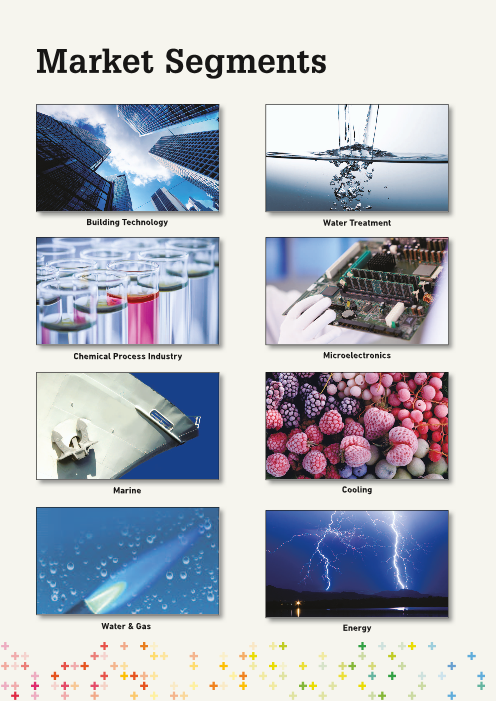
Market Segments
Building Technology Water Treatment
Chemical Process Industry Microelectronics
Marine Cooling
Water & Gas Energy
3
Page4
Market Segment
Water Treatment
Drinking Water Process Industrial Wastewater Treatment
4
Page5
Overview
Industrial Process Water
Water treatment, whether it is for municipal or
industrial applications, involve modifying the
properties of the water to reduce the impact on the
processes or the environment. Monitoring of the
quantity, quality, fi ltering, levels of pH, particulate
matter, salts, and chlorine levels are all important in
delivering clean water across the globe.
We have a solution to meet your application needs.
Depending on the application area, our customers
have to face di! erent challenges in water treatment
processes ranging from guaranteeing high water
qualities, to providing reliable measurements
to assuring stringent regulations. This is where
GF products are positioned to accommodate the
automation market by o! ering a wide range of valves,
pipes, fi ttings, and measurement and control options
to suit the most popular industrial applications.
GF o! ers product measurement solutions ranging
from:
– Flow
– pH/ORP
– Conductivity/Resistivity
– Temperature
– Pressure
– Level
– Chlorine
– Turbidity
– Dissolved Oxygen
Industrial Wastewater Treatment Municipal Wastewater Treatment
5
Page6
Application Areas
Industrial
Process Desalination
- Brackish Water
- Drinking Water
Water - Process Water
Long lasting solutions with a
focus on high water quality and
Media Filtration
purity
Water is an essential and indispensable element in
nearly all industrial processes. In sectors such as
food and beverage or pharmaceutical production,
water is either used as a primary product or in the
area of cooling, steam generation or boiler feed
systems. Using water in the industrial environment
requires consistently high water quality, namely
precisely defi ned physical parameters like ion purity,
acidity or conductivity.
High water quality in terms of purity for feed boilers,
production processes and cooling systems is the key
requirement and an absolute necessity for industry
today. Avoiding any form
of contamination, scale formation and corrosion is
achieved through applications such as deionization,
electrodialysis and new
membrane-based solutions. The plastic products
and additional technologies provided by GF Piping
Systems Signet product line, supports the industry
in designing an e! cient, reliable and cost e" ective
water treatment system. Signet instrumentation
technologies warrant a long service life, regardless
of how challenging the specifi c needs for pure
industrial process water may be.
6
Page7
Application Areas
Industrial
Wastewater
Chlorine Dioxide
Treatment
Reverse Osmosis
(Membrane Technology)
Cost e! ective solutions from
GF Piping systems for safety
conveying corrosive fl uids
even at elevated temperatures
Power plants, petrochemical complexes, steel mills,
or processing facilities and many other water
intensive industries are increasingly forced by
authorities to clean their wastewater before disposal
into rivers and lakes.
Wastewater treatment plants for inorganic caustics
and acids are small chemical plants themselves.
Corrosion resistance and sta! safety are the top
priority issues for waste containing piping systems.
GF Piping Systems’ philosophy for safe transport of
liquids and gases meets these advanced process
needs. GF products are designed for a maximum of
uptime reliability and maintenance simplicity and a
minimum of energy consumption during operation.
7
Page8
Application Areas
Drinking
Water
Process
GF Piping Systems o ers the
optimal system solution behind
the scenes
Producing drinking water is always a challenge. The
proper selection of plastic material for pipes, valves
and fi ttings according to their chemical and
mechanical properties is essential for the long-term
safe and reliable operation of treatment systems and
facilities. It is also imperative to choose the
appropriate instrumentation for chemical dosing and
process control, ultimately ensuring safe and reliable
product water quality.
At and between every stage of the process, from
plant intake to distribution, for all your conveyance,
measurement and control needs, the GF Piping
Systems package of products resists corrosion,
increases safety for personnel and equipment,
lowers maintenance costs, helps reduce bio-fouling,
and is quick and easy to install.
8
Page9
Reverse Osmosis Chlorine Dioxide
Reverse Osmosis
Municipal Sewage
Treatment
Media Filtration
Municipal Drinking Water Neutralization
9
Page10
Application Areas
Municipal
Wastewater
Treatment
Media Filtration
State-of-the-art systems from
GF Piping Systems for e! cient
and environmentally-friendly
wastewater treatment
Installation of e! cient and environmentally friendly
methods for municipal wastewater treatment
plants is one of the main challenges of our time.
Key developments such as the compilation of
wastewater treatment plants with water recycling
processes aim for optimization regarding quality,
life-cycle costs and environmental requirements.
Instead of discharging the treated e" uent into a
receiving water, reuse systems arrange further
purifi cation steps until the wastewater reaches
either potability status or fulfi lls an industrial
specifi cation. Advanced plastic solutions meet
those challenges, allowing signifi cant process
optimization at the same time.
Membrane technologies, chemical dosing systems
and polymer preparations are only some of the
applications that require e! cient and safe water
conveyance systems. With the high quality system
solutions of GF Piping Systems - o# ering pipes,
fi ttings, automation and instrumentation from one
source - the optimal compatibility of all components
is warranted.
Municipal Sewage
Treatment
10
Page11
Municipal Sewage Treatment
Municipal Sewage Treatment
Municipal Sewage Treatment
Municipal Sewage Treatment
11
Page12
Chlorine
Dioxide
Control
Chlorine dioxide is extremely volatile and cannot be
manufactured and transported safely in compressed
gas cylinders. A chlorine dioxide generator is used
on-site to manufacture chlorine dioxide. Chlorine
dioxide is formed when sodium chlorite is introduced
to either chlorine gas (Cl2), hypochlorous acid (HOCl),
or hydrochloric acid (HCl). The e! ciency of chlorine
dioxide to disinfect decreases (same as chlorine)
as temperatures become lower. Low temperatures
cause sodium chlorite to become separated into
layers (stratifi cation) and can damage the storage
vessel.
There are many uses for chlorine dioxide. It is used
for disinfection in water treatment for municipalities,
food, fruit and vegetable washing and beverage
manufacturing. It is also used as a slimicide in paper
and pulp machines and can be used in circuit board
cleansing in the electronics industry. It is commonly
used in wastewater treatment as well as industrial
water treatment in applications such as cooling Instruments
water utilities.
Ì 8900
Signet products o" er reliable measurement
solutions to monitor a cooling tower application. Ì 9900
1. Flow allows the user to monitor the volume of Ì 9950
liquid being treated with CIO2.
2. Monitor pH in CIO2 injection from the chlorine
Flow
dioxide generator. It is very e" ective over a wide
pH range. Ì 515
3. Monitor and control of temperature to ensure Ì 2536
maximum disinfection.
Ì 2551
4. Monitor a hydrostatic level using a temperature
sensor, to accurately indicate chemical feed
levels.
12
Page13
Signet
Chlorine Dioxide Panel
NaClO Signet
2
Signet Chlorine
Transmitter
Relay 1 Relay 2 Level
ENTER
ENTER
Signet
Instruments
HCl
ENTER
Return From
pH Cl Signet
Process Level
OUT
IN
Signet ClO2
Instrument Generator
4
0.00 100.00
To Signet0.00 100.00
ENTER
Drain InstrumentENTER
Signet Signet Signet
+GF+
Flow Temperature
Water ORP To
In Process
© 2017 Georg Fischer Signet LLC
pH/ORP Temperature
Ì 2724-2726 Ì 2350
Ì 2734-2736
Ì 2774-2777
Ì 2750/2751 Pressure
Ì 2760 Ì 2450
Chlorine
Ì 4632
13
Page14
Cooling
Towers
Corrosion,
Cooling towers are used to dissipate heat through Biocide, Anti-fouling
the cooling of a water stream as it passes through and Anti-scaling
Chemicals
the cooling tower. Most cooling towers remove the
heat through the evaporation of water in the tower.
Dry cooling towers use heat exchangers to transfer
the heat from the water to the air.
Signet
Common applications include cooling of processes
Instrument
within chemical, food processing, and manufacturing Cooling Tower
plants, power plant cooling, refrigerated warehouse
cooling, and building HVAC systems.
ENTER
Here are a few common challenges when dealing
with a cooling tower application. The importance
Signet
of protecting heat exchangers from the build up of Conductivity
scale, corrosion reduction in metal components of (optional)
the cooling system, pipes, heat exchangers, and
pumps is critical for an e! cient system. Reducing
ENTER
the danger of Legionella, and increasing e! ciency of
the cooling system and reducing water and chemical Signet Signet
consumption are additional factors as well. Makeup Flow Instrument
water
Operators may face some challenges relating to
acid cleaning to reduce scale build up, and heat Down
exchanger failure due to corrosion and possible
environmental and legal issues due to Legionella
exposure to the public, chemical and water expense
as well as sewer charges.
Signet products o" er reliable measurement Instruments
solutions to monitor a cooling tower application.
1. Maintain proper pH range to reduce corrosion, Ì 8900
scaling, and to maximize chemical treatment Ì 9900
program e! ciency.
2. Maintain biocide levels, through ORP control or Ì 9950
the use of a 4630-XX ampormetic chlorine
system, to prevent Legionella and biological
fouling in the system.
3. Maintain proper conductivity levels to reduce Flow
water usage and control scaling tendencies.
Ì 515
4. Calculate water evaporation by monitoring water
make up and water bleed o" for sewer charge Ì 2536
credit.
Ì 2551
5. Control chemical feed based on make up water
addition for corrosion protection and scaling Ì 2552
potential reduction.
6. Monitor closed loop pH and conductivity levels to
detect leakage or heat exchanger failures.
14
Page15
Signet Chlorine
Transmitter
Relay 1 Relay 2
ENTER
ENTER
Signet Signet
Instrument Chlorine
Panel
pH Cl
Signet
Flow OUT
IN
Drain
Return From
Heat Exchanger
4
Cooling Tower
0.00 100.00 Signet
0.00 100.00
Instrument
ENTER Signet ENTER ENTER
To Heat
Instrument
Exchanger
Signet Signet Signet Signet
Conductivity Flow pH ORP
ENTER
Signet Signet
Instrument Signet Conductivity Instrument
Flow Signet
Blow ENTER
(optional) Instrument
Down
© 2017 Georg Fischer Signet LLC
pH/ORP Conductivity
Ì 2724-2726 Ì 2818-2821
Ì 2734-2736 Ì 2839-2841
Ì 2764-2766 Ì 2850
Ì 2774-2777
Ì 2750/2751
Ì 2760
Chlorine
Ì 4630
15
Page16
Deionization
Mixed Bed
Twin Bed SignetSignet Acid Instrument
Instrument
Ultra-Pure Water SignetCaustic Level
ENTER
Deionization is the process of removing minerals from
water to produce pure water, which has a very low ENTER
and/or nominal mineral content, or ultra-pure water
mixer
which is virtually mineral free. This process typically
passes processed water through two separate beds,
cation and anion, followed by a mixed bed.
Signet
The production of Ultra-Pure Water (UPW) for use in an Instrument
industrial, pharmaceutical or laboratory environment
must meet the strictest standards to ensure high
purity and guarantee minimal contaminates. GF ENTER
Signets line of industrial sensors and metering pH
systems provides an accurate real time information to Signet
Level Neutralization
monitor the complete process from the infl uent line to Tank
the product water feeding the application and waste
water to the drain.
Depending on the specifi c application and the water
quality needed, the Ion exchange systems can contain
several banks of twin bed ion tanks, each tank would
be fi lled with either a cation or anion resin bead that
feed a single or bank of mixed bed which sometimes
referred to as a “polishing tank”, and is usually in line
after a double pass RO system or a two bed deionizer
system. The cation and anion resins in one tank
Instruments
allows the hydrogen and hydroxyls ions to combine
immediately to produce high quality pure water. Ì 8900
See how Signet products o! er reliable measurement
Ì 9900
solutions in various desalinaton applications.
1. Monitor fl ow in the amount of feed water being Ì 9950
cycled into the resin tanks.
2. Monitor the use of the product water being used in
Flow
the application.
3. Monitor and control the pH Neutralization process. Ì 515
Monitor the pH after the optional degasser has
stripped out the CO2. Ì 2536
4. Monitor conductivity in the infl uent water quality
a two tank or mixed bed system. This allows the
operator to verify the quality of the feed water or
RO product water.
5. Resistivity using a Conductivity sensor, monitors
the water quality of the product water to the
application or to the mix bed system.
6. Level using a Pressure sensor, monitors levels
in various tanks.
16
Page17
Chemical Regeneration
Signet Signet
Instrument Instrument
Acid Signet Caustic Signet
Level Level
Signet Signet
Instrument Instrument ENTERENTER
ENTER
Signet Signet ENTER
Flow Conductivity
Signet Signet
Flow Instrument
4
0.00 100.00
0.00 100.00
ENTER
Cation Anion
Signet Mixed
Instrument Bed
Signet
Conductivity/
Resistivity
ENTER
Signet Signet
pH Instrument Signet
Resistivity
Signet
Flow Twin Bed Mixed Bed
to drain
© 2017 Georg Fischer Signet LLC
pH/ORP Conductivity
Ì 2724-2726 Ì 2818-2821
Ì 2734-2736 Ì 2839-2841
Ì 2774-2777 Ì 2850
Ì 2750/2751
Ì 2760
Pressure/Level
Ì 2250
Ì 2450
17
Page18
Desalination
Brackish Water
Drinking Water
Process Water
With the increase in the world’s population and
a strain on potable water demands, desalination
plants and potable skids are utilizing the ocean
to meet the world’s water requirements. This is
especially true in remote locations where the cost of
distribution systems is costly.
The desalination process begins with a water
intake. Since water intakes can draws in more than
just water, it is necessary to have a multifaceted
fi lter system to remove the impurities, prior to Intake
reaching the RO fi lter system. The initial fi ltration Beach Well
process generally consists of multimedia and
cartridge fi lters, pH adjustments (if necessary)
and the injection of scale inhibitors to protect the
membrane.
After the initial fi ltration is completed, water is
pumped into RO membranes. The water pressure
must be maintained su! ciently high to overcome
the osmotic pressure for the RO membranes.
As the water passes the RO membrane, it is
separated into two fl ow streams, permeate and
concentrate. Permeate (product water with low
TDS) passes through the membrane and into a
storage tank in preparation for the fi nal stage of Instruments
desalination. Concentrate (wastewater), with high
concentration of brine, may be collected for further Ì 8900
processing before being returned to the ocean.
Ì 9900
See how Signet products o" er reliable
measurement solutions in various desalinaton Ì 9950
applications.
1. For drinking water, pH is monitored and
Flow
controlled, thru chemical additives for example,
to ensure the water does not corrode the pipes Ì 515
within the distribution systems.
Ì 2536
2. Monitor fl ow amount of incoming water being
processed. Low fl ow is a good indicator of Ì 525
clogged fi lters.
Ì 2551
3. Monitor discharge levels of brine or concentrate.
4. Conductivity measures and monitors infl uent
and e# uent TDS levels.
5. Level using Pressure sensor, measure the
hydrostatic level to accurately monitor levels of
stored process water.
18
Page19
Signet
Chlorine Panel
Signet
Signet Chlorine
Turbidity TransmitterRelay 1 Relay 2
ENTER
Signet
Instrument
Power Supply &
Wiring Terminals
Signet Turbidimeter
ENTER
ENTER
Drain pH Cl
Signet
OUT
Flow +GF+ Filtration
IN
Signet
Turbidity
Pre-Screening
Filtration Power Supply &
Wiring Terminals
Wastewater
Signet Turbidimeter
ENTER
Signet
Instrument
Drain
R.O. ENTER Signet
System Conductivity Signet
Instrument
Signet Chlorine
Instrument Addition
4
0.00 100.00 ENTER
4
Signet
0.00 100.00
0.00 100.00
Instrument
0.00 100.00
ENTER
Intake ENTER Signet
ORP
Reservoir
+GF+
Wastewater to
Outlet Distribution
Signet Signet Signet Signet System
Flow Conductivity Conductivity Flow Signet
Level ENTER
Signet
Instrument
© 2017 Georg Fischer Signet LLC
ORP Pressure/Level
Ì 2725, 2726 Ì 2250
Ì 2735 Ì 2450
Ì 2775-2777
Ì 2750/2751
2760 ChlorineÌ
Ì 4630
Conductivity Turbidity
Ì 2818-2821 Ì 4150
Ì 2839-2841
Ì 2850
19
Page20
Media
Filtration
Gravity media fi ltration is e! ective in reducing
turbidity, foul taste, and odor by removing impurities
through chemical absorption and physical straining
of the water between the media material. The
classic fi ltration technique uses pressurized water
that typically fl ows top down, passing through
several material layers, leaving suspended
particles behind. In multi-level fi ltration processes,
hydroanthracite or gravel can be used, in addition to
sand, to fi lter particles up to 10-15 μm from fl uids.
Some common issues in media fi ltration may
include: maintaining unit performance to design
parameters and maximizing service life, minimizing
fouling, prevention of scaling and minimizing
chemical attack. Customers may have experienced
problems with fi lter clogging, active carbon exhaust
or determining when to backwash.
Signet products are well suited in a media fi ltration
application. See how Signet products can provide a
solution for you.
1. Total fl ow tracks the amount of water processed
through the media. This is a good indicator for
planned maintenance.
2. Flow rate monitors the e# ciency and could be an Instruments
indication that the system needs to be
backwashed. Ì 8900
3. Infl uent or e$ uent pressure detects head loss. Ì 9900
As the fi lter system experiences head loss, this
Ì 9950
is a good indicator that the media is clogging or
may experience break through (fi lter allowing
large material to pass the fi lter media).
4. Measuring disinfectant levels detects the
e# ciency of the active carbon fi lter.
5. Increased turbidity levels could be an indicator
of break through.
20