




Georg Fischer Waga N.V.
Table of contents
Water & gas
Meet the vips
Around the world
The right choice
MULTI/JOINT The original!
User manuals
Tender specifications
Product range
Index
Conditions of sale
このカタログについて
| ドキュメント名 | WAGA - Product Range |
|---|---|
| ドキュメント種別 | 製品カタログ |
| ファイルサイズ | 34.8Mb |
| 取り扱い企業 | ジョージフィッシャー株式会社 (この企業の取り扱いカタログ一覧) |
この企業の関連カタログ



このカタログの内容
Page1
Georg Fischer Waga N.V.
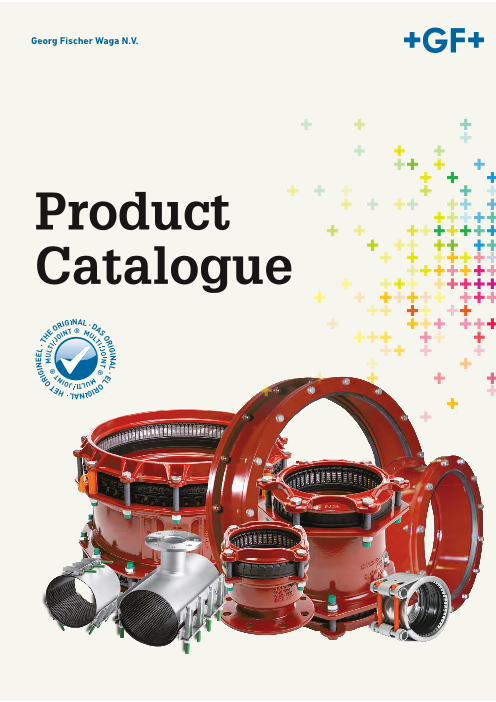
Product
Catalogue
Page3
+
For m
d oo rc eu m pre on d
o t
u
n a
ct
l ti in oe n d so ew e n ol uo ra
+ d center
Georg Fischer Waga N.V. + ww ww w.w wa.m ga.u nl ltijoint.nl
Georg Fischer Waga N.V. was founded in 1957 and has the main focus on the development, production and
sales of high quality connection techniques. For many years now, our products are successfully used around
the world in under and above ground water and gas applications for new construction, expansion and
maintenance & repair.
Table of contents
page
Water & gas 4
Meet the vips 6
Around the world 8
The right choice 10
MULTI/JOINT® The original! 12
Technical information 13
Terms and definitions 14
Conversion table 15
Pipe outside diameters 16
Pipe chart imperial 17
Material specifications 18
Coatings 20
Technical specification flanges 23
Insert stiffeners 25
MULTI/JOINT® 3000 Plus principle 27
User manuals 31
MULTI/JOINT® 3000 Plus DN50 - DN400 32
MULTI/JOINT® 3000 Plus DN425 - DN600 47
ST-System 62
Multi/Clamp 69
Insert Stiffeners 76
Tender specifications 79
MULTI/JOINT® 3000 Plus 80
ST-System 84
Multi/Clamp 85
Product range 87
Index 189
Conditions of sale 203
The technical data are not binding and not expressly warranted characteristics of the goods. They are subject to change. Please
consult our general conditions of supply.
3
Page4
Water & gas
4
Page5
Maintenance & repair
Maintenance and repair in under and above ground piping systems for water and gas requires no special
efforts with the products from the Georg Fischer Waga N.V. program. We offer a wide range of products,
which can be used for transport lines, distribution lines, house connections and service lines.
We offer various solutions for a variety of maintenance and Distribution lines
repair work. Whether the job is to connect, repair or drill, Distribution lines ensure water and gas distribution to
we have the right product. Quality and simplicity are always the end user. Through large diameter transport lines,
the most important characteristics of our products. With via distribution and service lines, water or gas reaches
our reliable fittings it is easy to make a maintenance free the end user. Whether it concerns new construction or
and long lasting connection. That is the strength of all our maintenance and repair applications, with products from
products and an absolute must for the users in the water the Georg Fischer Waga N.V. program distribution lines
and gas market! from DN50 up to DN400 can perfectly be installed.
Transport lines House connections and service lines
Transport lines carry water and gas from the source to the The last stage of the distribution grid is through pipelines
distribution lines. Distribution lines distribute the water that supply water or gas to the meter. These pipelines
or gas towards the end user. Transport lines, usually with are commonly known as house connections and service
large diameters, are repaired with large diameter fittings. lines. Through these pipe lines, with sizes of up to and
Especially for these large diameter transport lines we including DN50, the water and gas is brought into houses
developed products that can easily be used to connect and or buildings. We have developed products for connections
repair these pipelines from DN300 up to DN2200. to these smaller diameter pipe lines, such as saddles and
drilling devices.
5
Page6
Meet the VIPS
6
Page7
Our solutions
With all of our products we put quality and simplicity first. With our reliable fittings a quick, easy and
maintenance free connection can be made that will last for a long time. That is the strength of all our
products and for the water and gas market an absolute need!
DN50- DN400 DN425- DN600
+Wide range fittings
+Dedicated fittings
+Repair clamps &
tapping saddles
+Drilling devices
7
W400 / W410 Multi/Clamp ST-System MULTI/JOINT® 3000 Plus
UNI-Coupling MULTI/JOINT® 3000 Plus
Page8
Around the
world
8
Page9
Our reference cases
Whether it is connecting, repairing or tapping, our products can be used in a variety of applications. Our
product programs are succesfully implemented in the water and gas market in various applications
around the world.
+Reference cases in
wide range fittings
+Reference cases in
dedicated fittings
+Reference cases in
repair clamps &
tapping saddles
+Reference cases in
drilling devices
9
W400 / W410 Multi/Clamp ST-System MULTI/JOINT® 3000 Plus
UNI-Coupling MULTI/JOINT® 3000 Plus
Page10
The right
choice
10
Page11
Which product do you need?
Our products can be used for various applications. Therefore we would like to help you make the right
choice. In the below shown flow cart you can see which product is suitable for your application.
Which medium*
Water Gas
(EPDM) (NBR)
Which application
House House
Transport lines Distribution connections / Transport lines Distributionlines lines connections /service lines service lines
Which product
(on page)
MULTI/JOINT® MULTI/JOINT® MULTI/JOINT® 14 MULTI/JOINT
® MULTI/JOINT® MULTI/JOINT®
3000 Plus 3000 Plus 3000 Plus 3000 Plus 3000 Plus 3000 Plus
ST-System ST-System 45 ST-System ST-System
Multi/Clamp Multi/Clamp Multi/Clamp 55 Multi/Clamp Multi/Clamp Multi/Clamp
W400 / W410 W400 / W410 W400 / W410 83 W400 / W410 W400 / W410 W400 / W410
UNI-Coupling UNI-Coupling UNI-Coupling 88 UNI-Coupling UNI-Coupling UNI-Coupling
* For other fluids than water and gas, please contact your supplier.
11
Page12
MULTI/JOINT® The original!
Perfection in every detail MULTI/JOINT® 3000 Plus
Certified to
NSF/ANSI 61
Clamp ring:
ductile cast iron GGG45 EN-GJS-450-10
with Resicoat® epoxy powder coating
type RT 9000 R4
Uni/Fiks ring
Uni/Fikser:
stainless steel A4 (AISI 316)
Varioseal:
rubber gasket
(EPDM or NBR) Hygiene protection:
Ensures the fitting stays
clean from production
Body: to point of use
ductile cast iron
GGG45 EN-GJS-450-10 (cap in the
with Resicoat® epoxy picture:
powder coating DN50 -
type RT 9000 R4 DN400)
Nuts:
stainless steel A2 (AISI 304)
galvanised and passivated Washer:
or stainless steel A4 (AISI 316) stainless steel A2 (AISI 304)
galvanised and passivated or stainless steel A4 (AISI 316)
Bolts:
stainless steel A2 (AISI 304)
Lubo coated or stainless steel
A4 (AISI 316) Lubo coated
12
Page13
Technical
information
13
Page14
Terms and definitions
Terms and definitions used throughout this technical Gasket
manual comply (as much as possible) with the latest Sealing component of a joint.
terms and definitions used in the European standards.
Joint
Allowable operating pressure (PFA) Connection between the ends of two pipes and/or fittings in
Internal pressure, exclusive of surge that a component can which a gasket is used to effect a seal.
safely withstand in permanent service (see EN 805), often
referred to as working pressure. Joint angular deflection
Angle between the axis of two connected pipe components,
Allowable test pressure (PEA) which a flexible joint can accommodate.
Maximum hydrostatic pressure that a newly installed
component can withstand for a relatively short duration, Joint gap
when either fixed above ground level or laid and backfilled Maximum axial distance between any point of the spigot ends
underground in order to measure the integrity and of the pipes to be connected (coupling), or, maximum axial
tightness of the pipeline (see EN 805), often referred to as distance between any point of the spigot end of the pipe and
test pressure. Note: This test pressure is different from the the flange face (flange adaptor).
system test pressure (STP), which is related to the design
pressure of the pipeline, and is intended to ensure the Wide range coupling
integrity and leak tightness of a certain installed fitting. Fitting intended for use with pipes of various materials which:
• is used in a pipeline to make the connection between two
Nominal pressure (PN) spigots of pipes, fittings or valves
Numerical designation expressed by a number, which is • allows for radial and axial displacements in order to
used for reference purposes. facilitate easy assembly.
Nominal size (DN diameter nominal) Wide range flange adaptor
Numerical designation of size, which is common to all Fitting intended for use with pipes of various materials which:
components in a piping system. It is a convenient round • is used in a pipeline to make the connection with a spigot
number for reference purposes and is only loosely related of a pipe or a fitting and the flange of another component
to manufacturing dimensions (see EN ISO 6708). of the pipeline (e.g. pipe, fitting, valve)
• allows for radial and axial displacements in order to
Outside diameter (OD) facilitate easy assembly.
Outside diameter of the pipe(s) to be connected.
Wide range stepped or reducer coupling
Depth of engagement Large tolerance coupling intended for use with pipe
Minimum distance between any point of the spigot end and components of different nominal sizes.
the internal face of the joint gasket.
Performance test
Ductile cast iron Proof of design test, which is done once and is repeated only
Cast iron used for pipes, fittings and accessories in which after changing the design.
graphite is present, mainly in spheroidal form.
Restraint flexible joint
Fitting Flexible joint in which a means is provided to prevent
Casting other than a pipe, which allows pipeline deviation, separation of the assembled joint.
change of direction or bore. In addition flanged socket
pieces, flanged spigot pieces and collars are also classified Dimensions and units
as fittings. All dimensions used in this catalogue or other documentation
are indicated in mm and/or inches and are specified as
Flange nominal or standard sizes. We reserve the right to alter
Flat circular end of a fitting or pipe extending perpendicular design of fittings.
to its axis, with bolt holes equally spaced in a circle.
14
Page15
Conversion table
Convert to multiply by
Area
0.1550 sq. inch (in2) sq. centimetre (cm2) 6.4516
10.764 sq. feet (ft2) sq. metre (m2) 0.09290
Density
0.062428 pound/foot (UK) kilogram/metre3 (kg/m3) 16.0185
0.010022 pound/foot (UK) kilogram/metre3 (kg/m3) 99.776
10-3 gram/centimetre3 (g/cm3) kilogram/ metre3 1000
0.160544 pound/gal (UK) pound/foot3 (lb/ft3) 6.22884
Dynamic viscosity
103 centipoises (cP) Pascal second (Pa s) 10-3
2.419 pound/ft hr (lb/ft h) centipoises (cP) 0.4134
1.000 gram/metre sec (g/m s) centipoises (cP) 1.000
Length
0.0393701 inch (in) millimetre (mm) 25.40
0.28084 feet (ft) metre (m) 0.3048
1.090361 yard (yd) metre (m) 0.914400
1010 angstrom (A) metre (m) 10-10
Mass
0.035274 ounce (oz) gram (g) 28.3495
2.20462 pound (lb) kilogram (kg) 0.453592
0.96207 ton UK (long ton) tonne (t) 1.01605
Pressure and stress
9.869*10-3 atmosphere (atm) kilopascal (kPa) 101.30
0.1450 pound-force/in2 (psi) kilopascal (kPa 6.89476
0.01020 kilogram force/cm2 kilopascal (kPa) 98.0665
(kgf/cm2)
0.06804 atmosphere (atm) pound-force/in2 (psi) 14.70
20.89 pound-force/ft2 (lbf/ft2) kilopascal (kPa) 0.04788
10.000 milibar (mbar) kilopascal (kPa) 0.1000
33.86 milibar (mbar) inches mercury (in Hg) 0.02953
68.95 milibar (mbar) pound-force/in2 (psi) 0.01450
4.015 inches water (in H2O) kilopascal (kPa) 0.2491
Torque
0.7376 lb/feet Nm 1.35
multiply by to convert
15
Page16
Pipe outside diameters
Coupling Steel Steel PVC/PE PVC/PE Ductile Grey cast AC cl. 6/12
DN imp. metric metric imp. iron cl. 18 iron Brit.
-
50 60.3 60.3/66 63 60.3 66 68 -
65 76.1 76.1 75 76.1 82 - -
80 88.9 88.9 90 88.9 98 95 124
100 114.3 108 110/125 114.3 118 122 149/151
125 139.7 133 140 139.7 144 148 174
150 168.3 159 160/180 168.3 170 174 228
200 219.1 211/216 225 219.1 222 228 -
225 244.5 241 250 244.5 248 257 268/280
250 273 267 280 273 274 284 334
300 323.9 316/318 315/355 323.9 326 337 -
350 355.6 368 355 355.6 378 - -
400 406.4 419 400 406.4 429 - -
425 452 - - 457 - 442 -
450 457 464/470 - 457 480 -
475 508 - 500 508 - 495 -
500 508 514/521 500 508 532 - -
550 559 559 - - 558 548 550
600 609.6 622 630 609 632 635 -
Pipe outside diameters
Coupling AC cl. 10 AC cl. 10 AC cl. 12 AC cl. 12 AC cl. 18 AC cl. 10
DN rough. rough. rough.
approx. approx. approx.
50 68 - - - - -
65 - 72 74 78 - 86
80 98 102 - - 86 -
100 120 124 104/124 108/128 106/126 106/126
125 145 149 149 153 153 -
150 176 180 180 184 178 157/184
200 - - - - - -
225 232 236 238 242 234 244
250 284 288 292 296 288 296
300 340 346 350 356 344 354
350 - - - 356 344 354
400 - 402 410 416 402 414
425 452 460 - - 456 -
450 452 460 468 476 456 468
475 510 - - - 508 -
500 510 518 522 530 508 522
550 568 576 580 - 564 578
600 - - - - - -
16
Page17
Pipe chart imperial
17
Georg Fischer pipe and fittings O.D. chart MULTI/JOINT® www.waga.nl Certified to
NSF/ANSI 61
Nominal size MULTI/JOINT® Steel size Ductile size Cast size Sewer pipe Asbestos cement size
Range Range Std Ductile C900 A/C ME A/C ME A/C ME A/C A/C A/CInch mm (inch) (mm) steel IPS PVC IPS PE iron C905 DIPS PE Cast iron SDR35 Class Class Class RB RB RBPVC 100 150 200 Class 100 Class 150 Class 200
2 50 1.811-2.795 46-71 2.38
2 ½ 65 2.480-3.543 63-90 2.88
3 80 3.307-4.133 84-105 3.50 3.96 3.96 3.74 3.84 4.00 4.10 4.29
4 100 4.094-5.196 104-132 4.50 4.80 5.00 4.22 4.64 4.81 4.79-5.26 4.97-5.32 5.22-5.57
5 125 5.196-6.102 132-155 5.56
6 150 6.062-7.559 154-192 6.63 6.90 7.10 6.28 6.91 7.05-7.40 7.07-7.37 7.26-7.60
8 200 7.559-9.133 192-232 8.63 9.05 9.30 8.40 9.11 9.22-9.57 9.27-9.62 9.39-9.79
9 225 9.050-10.551 230-268
10 250 10.500-12.204 267-310 10.75 11.10 11.40 10.50 11.24 11.66 11.25 - 11.77 11.82 - 12.12 11.77 - 12.12
12 300 12.401-14.015 315-356 12.75 13.20 13.50 12.50 13.44 13.92 13.37 - 14.04 14.08 - 14.38 14.03 - 14.38
14 350 13.858-15.472 352-393 14.00 15.30 15.65 15.07 16.22 15.36 - 15.80 16.38 - 16.73 16.44 - 16.88
16 400 15.433-17.047 392-433 16.00 17.40 17.80 17.15 18.46 17.50 - 17.94 18.62 - 18.97 18.74 - 19.19
17 425 17.000-18.267 432-464
18 450 17.716-18.976 450-482 18.00 19.50 19.92 18.70 19.90 20.94 22.18 20.44 21.20
19 475 18.937-20.196 481-513
20 500 19.685-20.944 500-532 20.00 21.60 22.06 22.12 23.28 24.66 22.50 23.54
22 550 21.574-22.834 548-580
24 600 23.818-25.078 605-637 24.00 25.80 26.32 24.80 26.48 27.96 29.62 27.17 28.22
Please note that actual pipe outside diameters can vary. Please verify the exact pipe O.D. before ordering fittings. The fittings are also suitable for pipe materials that are not listed. Please contact us for more information.
MULTI/JOINT® restraint version for water applications: 2” - 12” = wp 232 psi, 14” - 24” = wp 150 psi
Installation Torque
MULTI/JOINT® size:
DN Inch Nm ft-lbf
50 2” 30 20
65 2,5” 40 30
80 3” 60 45
100-125-150-200 4-5-6-8” 120 90
225-600 9-24” 140 100
Georg Fischer Waga N.V. - P.O. Box 290 - 8160 AG - EPE - The Netherlands
T +31 578 678378 - F +31 578 620848 - waga.ps@georgfischer.com
Pipe chart imperial - 01-2018
Page18
Material specifications
Ductile cast iron Mechanical properties
Conforming to EN-GJS-450-10 HB200 (GGG 45). General AISI 304
description: cast iron (used for pipes, fittings and
accessories) in which graphite is present mainly in Hardness, Brinell 123 converted from
spheroidal form. Rockwell B hardness
Tensile strength, ultimate 565 N/mm2
MULTI/JOINT® Tensile strength yield 310 N/mm2
Mechanical properties EN 1563:1997 Elongation at break 70% in 50 mm
GGG45
Symbol EN-GJS-450-10
HB 200 Stainless steel AISI 316, A4 quality X 5CrNiMo 17122
Tensile strength R min. 450 N/mm2 Conforming to DIN 1.4401, ISO 6931. General
m
0,2% Proof Stress R min. 310 N/mm2 description: molybdenum content increases resistance
p0,2
Elongation at break min. 10% to marine environments. High creep strength at elevated
Modulus at elasticity 169 GN/mm2 temperatures and good heat resistance Biocompatible.
Predominant structure Ferrite Fabrication characteristics are similar to types 304.
Thermal properties
Steel 37-2, ASTM A108
Conforming to DIN 1.0112, BS 970 080A17. General CTE, linear 17.3 µm/m- °C
description: medium low-carbon steel with a good 20 °C from 0-100 °C
weldability and slightly better machine-ability.
Mechanical properties ISO R 1038 Mechanical properties
AISI 316
Hardness, Brinell 126
Tensile strength, ultimate 140 N/mm2 Hardness, Brinell 190
Tensile strength yield 370 N/mm2 Tensile strength, ultimate 620 N/mm2
Elongation at break 15% in 50 mm Tensile strength yield 415 N/mm2
Modulus of elasticity 205 GPa typical for Elongation at break 45% in 50 mm
steel Modulus at elasticity 205 GPa
Stainless steel AISI 304, A2 quality X 5CrNi 189 Rubber
Conforming to DIN 1.4301, ISO 683/13 11. General Rubbers are available in many shapes and qualities.
description: austenitic CR-Ni stainless steel. High ductility, Rubbers are an essential component of fittings and valves
excellent drawing, forming and spinning properties. in pipeline constructions. Depending on the transported
Essentially non-magnetic, becomes slightly magnetic media and temperature, a choice has to be made for a
when cold worked. Chemical resistance: resists most sealing material. All the different materials have their own
oxidizing acids and salt spray. Low carbon content means specific quality and applications.
less carbide precipiation in the heat-affected zone during
welding and a lower susceptibility to intergranular The basic understandings
corrosion. There still exists some confusion regarding the
material rubber and the methods by which products
Thermal properties are manufactured of it. Natural or synthetic rubber is
combined with several chemicals through mixing and
CTE, linear 17.3 µm/m- °C rolling, resulting in the socalled non vulcanised rubber
20 °C from 0-100 °C mixture. The added chemicals are often more important
Modulus of elasticity 193-200 GPa than the rubber raw material, for characteristics of the
final product. Such a rubber mixture, a viscous, plastic
18
Page19
mass, will be processed further into the required product, EPDM
by a variety of methods. To form the product to its final Ethylene-propylene-diene-monomer rubber. By copoly-
shape, moulds are required to shape the material either by merisation of ethane and propane, an elastomer arises
transfer moulding machines or compression presses. The without double bindings, that can only be vulcanised with
rubber mixture is introduced in the mould under pressure, peroxides. If with polymerisation a third monomer is built
at a temperature of about 150 °C, resulting in a chemical in, the elastomer can be vulcanised with sulphur (EPDM).
reaction, which transforms the mixture into a formed, EPDM is very well resistant against weather influences in
elastic product. One should be fully aware of the required general and ozone especially. Besides that, the material
quality standard, in order to decide on the compound to be is excellently resistant against high temperatures, hardly
used. sensitive to corrosion, and resistant against free-basing,
acid and solvents. Depending on the mixture and type of
NBR vulcanisation, the maximum temperature for use of EPDM is
Nitrile Butadiene Rubber. Rubber seals should conform to around 120 °C. All EPDM seals used by Georg Fischer Waga
certain requirements, such as: N.V. meet the requirements of EN 681-1/ WA.
NEN 5601 Hardness with shore A
NEN-ISO 37 Determination tension and stress Application EPDM Drinking water
properties
NEN-ISO 48 Hardness with 1 RHD
NEN-ISO 188 Tests for accelerated ageing Temperature 0 °C to +50 °C
NEN-ISO 815 Determination of permanent Hardness 70 IRHD
deformation
NEN-ISO 816 Determination of abrasion strength
NEN-ISO 1431 Determination of ozone resistance Perbunan
EN-ISO 1817 Determination of resistance against All Perbunan seals used by Georg Fischer Waga N.V. meet
fluids the requirements of EN 682 for gas applications and are
NEN-ISO 2285 Determination of permanent stretch suitable for use in drinking water systems.
at temperature
Application Perbunan Gas-, drinking- and
NBR rubber is eminently resistant against gas, oil, grease, waste water systems
petrol and solvents. The resistance is strongly dependent
on the Acrylonitril percentage; the best results are achieved Temperature -30 °C to +100 °C
with high percentages. However the elasticity, the resistance Hardness approx. 60 shore A
against permanent transformation and the low temperature
resistance will decrease. The material is sensitive to
corrosion by ozone. At lower temperatures, NBR will stiffen. Guidance on storage of rubber seals
Depending on the mixture, the maximum temperature for In case there is any doubt about the suitability of the rubber
use can be up to around 90 °C. By complete immersion in for sealing for certain applications, please contact us. The
example oil, NBR can be used up to around 120 °C. NBR is rubber seals should:
also suitable for use in drinking and waste water systems. • have a storage temperature below 25 °C and preferably
All NBR seals used by Georg Fischer Waga N.V. meet the below 15 °C,
requirements of EN 682 GB for gas applications, and are • be protected from light, in particular strong sunlight and
suitable for use in drinking water systems. artificial light with a high UV content,
• not be stored in a room with any equipment capable
Application NBR Gas-, drinking- and of generating ozone, e.g. Mercury vapour lamps, high
waste water systems voltage electrical equipment, which may give rise to
electrical sparks or silent electrical discharges,
Temperature -5 °C to +50 °C • be stored in a relaxed condition free from tension,
Hardness 60 to 70 IRHD compression or other deformation,
• be maintained in a clean condition.
19
Page20
Coatings
Coating for corrosion protection as the parts are only heated up to approximately 200 °C.
To ensure a durable, high quality corrosion protection of The application processes of epoxy coatings, Fluidised Bed
castings (and other metals), coatings must be resistant to Coating or Electro static Spray Application, allow automatic
temperature changes and the effects of weather and other manufacturing processes and result in a homogeneous
environmental influences such as moisture, industrial layer thickness inside and outside of the fittings, formed
gases etc., which stress the casting. The coating must by one material without discontinuity. Consequently it
ensure a completely sealed surface without porous areas. offers excellent edge coverage. We were one of the first
A protective coating prevents corrosion and the formation coupling manufacturers who started to have their product
of corrosion products which, when carried along the protected with an epoxy coating ever. Since we introduced
pipeline, could lead to disruption at other points. A smooth the epoxy coated couplings in the beginning of 1987, we
surface reduces friction between the transported medium have built up a lot of experience and know-how. Within
and the fitting. Encrustation by salts or organic materials the European Standard work groups, the tendency is very
is avoided. clearly towards epoxy coatings instead of other coatings.
As a member of GSK, Georg Fischer Waga N.V. contributes
Epoxy coatings to lifting the standards for epoxy coating used in the
Coatings on the basis of epoxy resin are the best way of (utility) market.
protecting castings. Epoxy powder coatings offer long-
term reliability. The coating protects the entire surface Resicoat® RT 9000 R4 (red)
area, with a film thickness of minimum 250 µm. It has no Resicoat® has a very high durability. It shows very high
pinholes, tested with 3 kV. The epoxy resin technology impact resistance and offers a good electrical insulation.
uses less energy compared to other coating processes, Values measured on blast cleaned cast iron.
Resicoat® Technical data
Minimum thickness 250 µm according to GSK
Colour Ruby Red, RAL 3003
Basis Epoxy resin
Impact resistant 20 joule at 23 °C according to DIN 30671
Porosity 0 (zero) 3 kV test
Elasticity 5% at 23 °C according to DIN 30671 and DIN 30677-25
Flexibility 11% at 23 °C according to ASTM 522
Pressure resistance 100 µ at 90 °C according to DIN 30671
Hardness Shore D 98 / > 100 according to EN ISO 2815
Adhesion > 20 N/mm2 according to DIN 53232 and
> 16 MPa according to DIN ISO 4624
Salt spray test > 720 hours according to ASTM B 117
Maximum temperature 135 °C according to VDE 0368
Edge coverage Excellent
CD-properties Excellent at 30 days, 23 °C
Chemical resistance pH 2 up to pH 13
Breakdown voltage > 3 kV at 250 µm according to ISO 8130-2
Water absorption 100 days, 23 °C < 2% according to DIN 53495
100 days, 65 °C < 3% according to DIN 53495
Water immersion (5 y.) no blisters ISO 7253
Cathodic disbandment test at 23 °C < 10 mm DIN 30677-2
20