



- System Specification - for SYGEF Plus Piping Systems in High Purity Polyvinylidene fluoride
This specification covers requirements for the GF PIPING SYSTEMS SYGEF Plus(PVDF-HP) Piping System intended for a wide range of applications including ultrapure and deionized water, as well a wide range of chemical applications.
The components of the SYGEF Plus (PVDF-HP) piping systems are in accordance with the following standards.
このカタログについて
| ドキュメント名 | SYGEF Plus(PVDF-HP) - System Specification |
|---|---|
| ドキュメント種別 | 製品カタログ |
| ファイルサイズ | 381.1Kb |
| 取り扱い企業 | ジョージフィッシャー株式会社 (この企業の取り扱いカタログ一覧) |
この企業の関連カタログ


このカタログの内容
Page1
1. Scope
- System Specification -
for SYGEF Plus Piping Systems in High Purity Polyvinylidene fluoride
(PVDF-HP)
1. Scope
This specification covers requirements for the GF PIPING SYSTEMS SYGEF Plus
(PVDF-HP) Piping System intended for a wide range of applications including
ultrapure and deionized water, as well a wide range of chemical applications. The
components of the SYGEF Plus (PVDF-HP) piping systems are in accordance with
the following standards.
2. Basic System Data
2.1 Material Specification for SYGEF Plus (PVDF-HP)
SYGEF Plus (PVDF-HP) pipes, fittings and valves from GF Piping Systems are
manufactured from a virgin polyvinylidene fluoride resin material, unpigmented and
opaque, of which pipes and fittings are designed for 25 years of operational life with
water at 20°C.
The raw material used is designed for use with pressure bearing piping systems with
long term hydrostatic properties in accordance with EN ISO 10931, as supplied by
GF Piping Systems.
2.2 Characteristics of SYGEF Plus (PVDF-HP)
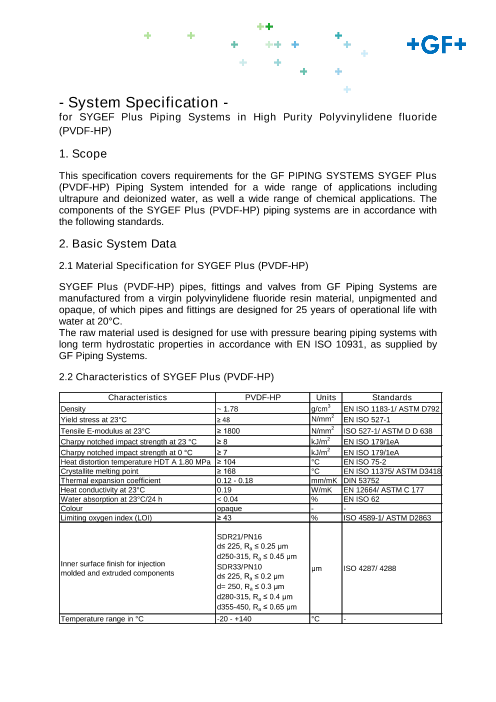
Characteristics PVDF-HP Units Standards
Density ~ 1.78 g/cm3 EN ISO 1183-1/ ASTM D792
Yield stress at 23°C ≥ 48 N/mm2 EN ISO 527-1
Tensile E-modulus at 23°C ≥ 1800 N/mm2 ISO 527-1/ ASTM D D 638
Charpy notched impact strength at 23 °C ≥ 8 kJ/m2 EN ISO 179/1eA
Charpy notched impact strength at 0 °C ≥ 7 kJ/m2 EN ISO 179/1eA
Heat distortion temperature HDT A 1.80 MPa ≥ 104 °C EN ISO 75-2
Crystallite melting point ≥ 168 °C EN ISO 11375/ ASTM D3418
Thermal expansion coefficient 0.12 - 0.18 mm/mK DIN 53752
Heat conductivity at 23°C 0.19 W/mK EN 12664/ ASTM C 177
Water absorption at 23°C/24 h < 0.04 % EN ISO 62
Colour opaque - -
Limiting oxygen index (LOI) ≥ 43 % ISO 4589-1/ ASTM D2863
SDR21/PN16
d≤ 225, Ra ≤ 0.25 μm
d250-315, Ra ≤ 0.45 μm
Inner surface finish for injection SDR33/PN10
molded and extruded components μm ISO 4287/ 4288d≤ 225, Ra ≤ 0.2 μm
d= 250, Ra ≤ 0.3 μm
d280-315, Ra ≤ 0.4 μm
d355-450, Ra ≤ 0.65 μm
Temperature range in °C -20 - +140 °C -
Page2
GF Piping Systems
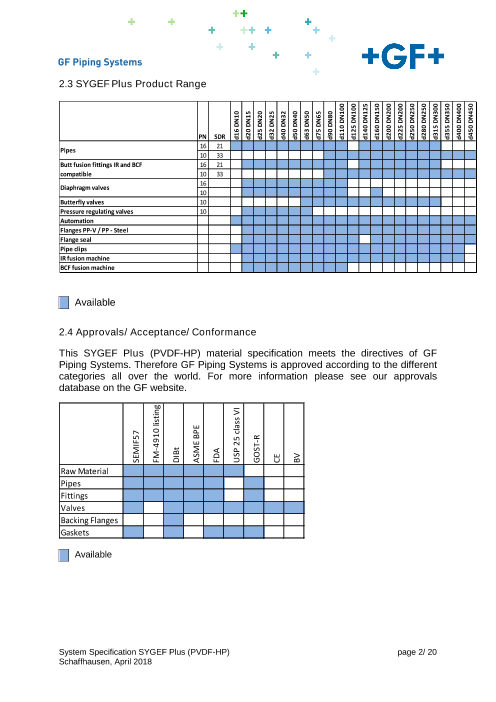
2.3 SYGEF Plus Product Range
PN SDR
Pipes 16 21
10 33
Butt fusion fittings IR and BCF 16 21
compatible 10 33
Diaphragm valves 16
10
Butterfly valves 10
Pressure regulating valves 10
Automation
Flanges PP-V / PP - Steel
Flange seal
Pipe clips
IR fusion machine
BCF fusion machine
Available
2.4 Approvals/ Acceptance/ Conformance
This SYGEF Plus (PVDF-HP) material specification meets the directives of GF
Piping Systems. Therefore GF Piping Systems is approved according to the different
categories all over the world. For more information please see our approvals
database on the GF website.
Raw Material
Pipes
Fittings
Valves
Backing Flanges
Gaskets
Available
System Specification SYGEF Plus (PVDF-HP) page 2/ 20
Schaffhausen, April 2018
SEMIF57
FM-4910 listing
DIBt
ASME BPE
FDA
USP 25 class VI d16 DN10
d20 DN15
GOST-R d25 DN20
d32 DN25
CE
d40 DN32
BV d50 DN40
d63 DN50
d75 DN65
d90 DN80
d110 DN100
d125 DN100
d140 DN125
d160 DN150
d200 DN200
d225 DN200
d250 DN250
d280 DN250
d315 DN300
d355 DN350
d400 DN400
d450 DN450
Page3
3. Pipes
- System Specification -
3. Pipes
All SYGEF Plus (PVDF-HP) pipes in high purity polyvinylidene fluoride (PVDF-HP)
shall be metric sizes d16 (3/8") – d450 (18"), manufactured in accordance with the
requirements of EN ISO 10931, Furthermore the pipes shall be manufactured stress
free and thermally annealed (max. internal stress of 2,5 N/mm²), without any voids
and inclusions, allowing a high grade of roundness, high degree of straightness and
an extreme smooth surface (see “2.2 Characteristics of high purity polyvinylidene
fluoride (PVDF-HP) - Inner surface finish for injection molded and extruded
components”).
Pipes shall be produced under ISO 14644-1 Class 6 (U.S. Fed. Standard 209E Class
1’000) conditions and the inner surface of the pipes must only come in contact with
clean room class 5 (100) quality air. Subsequent quality inspection and double
bagging procedure shall be done under constant laminar flow in class 5 (100)
conditions.
Testing will be done in accordance with EN 10204.
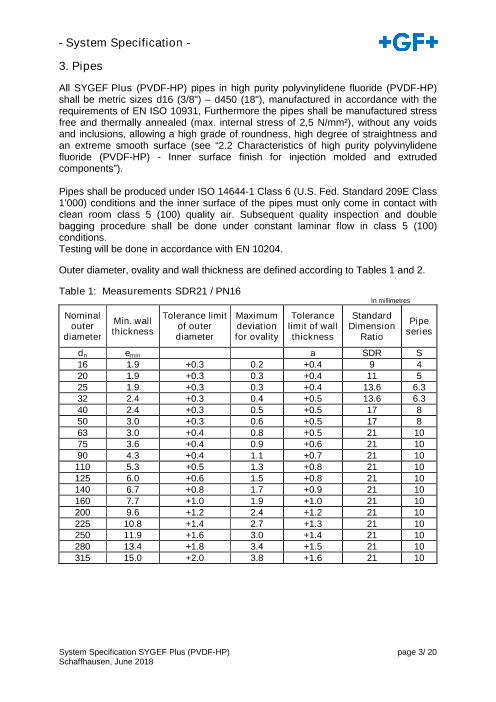
Outer diameter, ovality and wall thickness are defined according to Tables 1 and 2.
Table 1: Measurements SDR21 / PN16
In millimetres
Nominal Min. wall Tolerance limit Maximum Tolerance Standard outer of outer deviation limit of wall Dimension Pipe
diameter thickness diameter for ovality thickness Ratio series
dn emin a SDR S
16 1.9 +0.3 0.2 +0.4 9 4
20 1.9 +0.3 0.3 +0.4 11 5
25 1.9 +0.3 0.3 +0.4 13.6 6.3
32 2.4 +0.3 0.4 +0.5 13.6 6.3
40 2.4 +0.3 0.5 +0.5 17 8
50 3.0 +0.3 0.6 +0.5 17 8
63 3.0 +0.4 0.8 +0.5 21 10
75 3.6 +0.4 0.9 +0.6 21 10
90 4.3 +0.4 1.1 +0.7 21 10
110 5.3 +0.5 1.3 +0.8 21 10
125 6.0 +0.6 1.5 +0.8 21 10
140 6.7 +0.8 1.7 +0.9 21 10
160 7.7 +1.0 1.9 +1.0 21 10
200 9.6 +1.2 2.4 +1.2 21 10
225 10.8 +1.4 2.7 +1.3 21 10
250 11.9 +1.6 3.0 +1.4 21 10
280 13.4 +1.8 3.4 +1.5 21 10
315 15.0 +2.0 3.8 +1.6 21 10
System Specification SYGEF Plus (PVDF-HP) page 3/ 20
Schaffhausen, June 2018
Page4
- System Specification -
Table 2: Measurements SDR33 / PN10
In millimetres
Nominal Min. wall Tolerance limit Maximum Tolerance Standard outer thickness of outer deviation limit of wall Dimension
Pipe
diameter diameter for ovality thickness Ratio series
dn emin a SDR S
75 2.3 +0.4 0.9 +0.5 33 16
90 2.8 +0.4 1.1 +0.5 33 16
110 3.4 +0.5 1.3 +0.6 33 16
125 3.9 +0.6 1.5 +0.6 33 16
140 4.3 +0.8 1.7 +0.7 33 16
160 4.9 +1.0 1.9 +0.7 33 16
200 6.2 +1.2 2.4 +0.9 33 16
225 6.9 +1.4 2.7 +0.9 33 16
250 7.7 +1.6 3.0 +1.0 33 16
280 8.6 +1.8 3.4 +1.1 33 16
315 9.7 +2.0 3.8 +1.2 33 16
355 10.9 +2.2 4.1 +1.3 33 16
400 12.3 +2.4 4.5 +1.5 33 16
450 13.8 +2.7 5.1 +1.6 33 16
The mean outer diameter (dem) is the average value which results from the
measurements of the outer diameter at an interval of dn and 0.1 dn to the end of the
test piece. It is determined by measuring the circumference to 0.1 mm accuracy with
a measuring tape.
The mimimum and maximum wall thickness is determined to 0.1 mm, whereby the
measurement points should be distributed on the pipe circumference as evenly as
possible. All measured values must be within the allowable tolerance limit.
Ovality is the difference between the measured maximum and the measured
minimum external diameter (de) at the same cross-section. It is calculated to 0.1 mm
and measured immediately after production. The ovality requirement applies to the
timepoint of manufacture.
3.1 Product Marking
The pipes are embossed with a permanent identification during the production
process to ensure full traceability.
All pipes are marked permanently and consecutively
• Material identification: +GF+ SYGEF Plus
• Material code: PVDF
• Pipe diameter, wall thickness, SDR and PN
• Product standard: ISO 10931
• Manufacture date, shift and machine number
• Approvals / Conformance: DIBT-Approval, FM4910 listing
System Specification SYGEF Plus (PVDF-HP) page 4/ 20
Schaffhausen, June 2018
Page5
4. Fittings
- System Specification -
3.2 Packaging and Labelling
The packaging must ensure that the pipes are not damaged during transportation
and the high purity properties and handling are maintained.
Packaging and labelling must meet the following requirements:
• Pipes capped on each end
• Each pipe double bagged in a specified inner and outer bag under clean room
ISO 14644-1 Class 5 (U.S. Fed. Standard 209E Class 100) conditions
• Identification of the content, in type, quantity and product details
• Information about standards and approvals covered by the product
• Content of the label has to accomplish legal requirements
• Labels must be EAN coded for automatic identification
• Comply to GF standards as well as to international standards such as ISPM
15
4. Fittings
All SYGEF Plus (PVDF-HP) fittings shall be sizes d20 (1/2") – d450 (18") as butt
fusion type and manufactured in accordance with the requirements of ISO 10931 and
the Fittings shall have an extreme smooth surface (see “2.2 Characteristics of high
purity polyvinylidene fluoride (PVDF-HP) - Inner surface finish for injection molded
and extruded components”).
All butt fusion fittings shall be manufactured with laying lengths designed for use with
the manufacturer offered Infrared (IR) or BCF (Bead and Crevice Free) welding
machines.
All threaded connections shall have pipe threads in accordance with the
requirements of ISO 7-1.
Fittings shall be produced under ISO 14644-1 Class 5 (U.S. Fed. Standard 209E
Class 100) conditions. The quality inspection, cleaning procedure with 18MΩ pure
water, and the double bagging procedure shall be done under clean room ISO
14644-1 Class 5 (U.S. Fed. Standard 209E Class 100) conditions.
Testing will be done in accordance with EN 10204.
Unions in high purity polyvinylidene fluoride (PVDF-HP) shall be designed to have the
O-ring seals flush with the interior surface of the pipeline. O-rings used for this Union
shall be FKM-white and conform to USP 25 class VI and FDA.
4.1 Product Marking
The fittings are embossed with a permanent identification during the production
process to ensure full traceability.
Each part is marked according to EN ISO 10931:
• Logo of the manufacturer
• SDR (Standard Dimension Ratio) rating or PN (Nominal Pressure) or s (pipe
series)
• Dimension
• Material
• Permanently embossed date indicating the year and the production series
System Specification SYGEF Plus (PVDF-HP) page 5/ 20
Schaffhausen, June 2018
Page6
5. Accessories
- System Specification -
4.2 Packaging and Labelling
The packaging must ensure that the fittings are not damaged during transportation
and the high purity properties and handling are maintained.
Packaging and labelling must meet the following requirements:
• Each component double bagged in a specified inner and outer bag under
clean room ISO 14644-1 Class 5 (U.S. Fed. Standard 209 E Class 100)
conditions
• Identification of the content, in type, quantity and product details
• Information about standards and approvals covered by the product
• Content of the label has to accomplish legal requirements
• Labels must be EAN coded for automatic identification
• Comply to GF standards as well as to international standards such as ISPM 1
5. Accessories
5.1 Backing Flanges
Backing flanges in metric sizes DN15-400 shall be designed according to ISO 9624,
in a thermo plastic-oriented design, consisting of 100% glass fibre reinforced
polypropylene, PP-GF30, graphite black and UV stabilized. These flanges are
manufactured in a seamless technology injection moulding process by GF Piping
Systems. The flange is optimized with a V-groove in the inner diameter to ensure an
evenly distributed force on the thermo plastic flange adapter. The backing flanges
shall be marked with dimension, PN-value, standards, brand and lot number.
Connecting dimensions metric according to ISO 7005, EN 1092; Bolt circle diameter
PN10; Inch: ANSI B 16.5, BS 1560; class 150 (1/2” – 12”).
As an alternative backing flanges in metric sizes DN15-400 shall be designed
according to ISO 9624, in a thermo plastic-oriented design, consisting of glass fibre
reinforced polypropylene, PP-GF30, graphite black and UV stabilized with steel
inserts. The backing flanges shall be marked with dimension, PN-value, standards,
brand and lot number. Connecting dimensions metric according to ISO 7005, EN
1092; Bolt circle diameter PN10 (DN15-400) + PN16 (DN15-400); Inch: ANSI B 16.5,
BS 1560; class 150 (1/2” – 8”).
As an alternative backing flanges ANSI sizes d355 DN350 14” – d450 DN450 18”
shall be designed in a thermo plastic-oriented design, consisting of PVDF coated
steel. Connecting dimensions Inch ANSI B16.5, BS1560, class 150 (14”-16”).
5.2 Gaskets
Gaskets in metric sizes DN10–450 shall consist of elastomeric material according to
EN681, designed with or without metal reinforcement for use with flange adaptors
according ISO 10931. Gaskets with reinforcement shall be designed to be centred by
the outer diameter. Gaskets without reinforcement >DN100 shall provide fixation aids
to fit on the flange bolts.
System Specification SYGEF Plus (PVDF-HP) page 6/ 20
Schaffhausen, June 2018
Page7
- System Specification -
5.3 Pipe Support System
Pipe Support System shall be KLIP-IT, sizes d16-400, supplied by GF Piping
Systems.
6. Valves
All SYGEF Plus (PVDF-HP) valves shall be produced and pressure tested under ISO
14644-1 Class 5 (U.S. Fed. Standard 209E Class 100) conditions. The quality
inspection, cleaning procedure with 18MΩ pure water, and the double bagging
procedure shall be done under clean room ISO 14644-1 Class 5 (U.S. Fed. Standard
209E Class 100) conditions.
6.1. Ball Valves
Ball valves are not offered in SYGEF Plus (PVDF-HP), but they are available in
SYGEF Standard (PVDF). Please refer to this specification template.
6.2 Diaphragm Valves
6.2.1 Manual Diaphragm Valves
6.2.1.1 Diaphragm Valves DN15 to DN100
All SYGEF Plus (PVDF-HP) diaphragm Valves, with metric sizes DN15-100, shall be
either:
• Type 514 (true double union design, DN15-50), or
• Type 515 (spigot design, DN15-50), or
• Type 517 (flange design, DN15-50), or
• Type 519 (T-type design, DN15-15 to DN100-50)
All diaphragm Valves shall be manufactured by GF Piping Systems in accordance
with EN ISO 16138. The upper body shall be PPGF (polypropylene glass fibre
reinforced) connected to the lower body with a central union avoiding exposed
screws.
A two coloured position indicator integrated into the hand wheel must be present to
determine diaphragm position. The hand wheel shall have an integrated locking
mechanism.
Diaphragms are to be EPDM, FKM, NBR, PTFE with EPDM or FKM backing
diaphragm. Following options shall be available:
• PN16 pressure rating (upper body shall be black PPS GF (polyphenylene
sulphide glass fiber reinforced) for water applications only)
• Electrical feedback unit with either AgNi or AU contacts
• Pressure proof housing
The diaphragm valve shall have following KV values:
System Specification SYGEF Plus (PVDF-HP) page 7/ 20
Schaffhausen, June 2018
Page8
- System Specification -
d DN KV
[mm] [mm] [l/min @ ΔP=1 bar]
20 15 125
25 20 271
32 25 481
40 32 759
50 40 1263
63 50 1728
6.2.1.2 Diaphragm Valves DN65 to DN150
All SYGEF Plus (PVDF-HP) diaphragm valves, with metric sizes, shall be Type 317
(flanged design, DN 65-150)
All diaphragm valves shall be manufactured by GF Piping Systems in
accordance with EN ISO 16138. The upper body shall be PPGF (polypropylene glass
fibre reinforced) connected to the lower body with exposed stainless steel bolts. A
position indicator integrated into the hand wheel must be present to determine
diaphragm position. Diaphragms are to be EPDM, FKM, NBR, or PTFE with EPDM or
FKM backing diaphragm.
6.2.2 Pneumatic Diaphragm Valves
6.2.2.1 Pneumatic Diaphragm Valves DN15 to DN50
All SYGEF Plus (PVDF-HP) diaphragm Valves, with metric sizes DN15-50, shall be
either:
• true double union design, DN15-50, or
• spigot design, DN15-50, or
• flange design, DN15-50
• T-type design, DN15-15 to DN100-50
All diaphragm Valves shall be manufactured by GF Piping Systems in accordance
with EN ISO 16138. The upper body shall be connected to the lower body with a
central union avoiding exposed screws. Diaphragms are
to be EPDM, FKM, NBR, PTFE with EPDM or FKM backing diaphragm
The diaphragm valve shall have following KV values:
d DN KV
[mm] [mm] [l/min @ ΔP=1 bar]
20 15 125
25 20 271
32 25 481
40 32 759
50 40 1263
63 50 1728
Pneumatic actuators shall be GF Piping Systems Type DIASTAR or 604/605 and
shall be available as
System Specification SYGEF Plus (PVDF-HP) page 8/ 20
Schaffhausen, June 2018
Page9
- System Specification -
• DIASTAR Ten for PN up to 10 bar (one side)
• DIASTAR TenPlus for PN up to 10 bar (both sides)
• DIASTAR Sixteen for PN up to 16 bar (one side)
The mode of operation shall be fail safe close (FC), fail safe open (FO) and double
acting (DA). The valves shall have an integrated optical position indicator. Actuator
housing shall be made of PPGF (polypropylene glass fibre reinforced). Actuators with
FC mode shall contain a preloaded galvanised steel spring assembly to ensure safe
actuator operation and maintenance. The actuator DIASTAR Ten and DIASTAR
Sixteen shall have following accessories available:
• Solenoid pilot valve remote or direct mounted in voltages 24VDC/AC,
110VAC, 230VAC
• Positioner Type DSR 500-1
• Feedback with following limit switches AgNi, Au, NPN, PNP, NAMUR
• Stroke limiter & emergency manual override
• ASI controller
6.2.2.2 Pneumatic Diaphragm Valves DN65 to DN150
All SYGEF Plus (PVDF-HP) diaphragm valves, with metric sizes shall be flanged
design, DN65-150.
All diaphragm valves shall be manufactured by GF Piping Systems in
accordance with EN ISO 16138. The upper body shall be connected to the lower
body with exposed stainless steel bolts. Diaphragms are to be EPDM, FKM, NBR, or
PTFE with EPDM or FKM backing diaphragm.
Pneumatic diaphragm actuators shall be GF Piping Systems Type
DIASTAR Type 025. The mode of operation shall be fail safe close (FC), fail safe
open (FO) and double acting (DA). The valves shall have an integrated optical
position indicator. Actuator housing shall be made of PPGF (polypropylene glass
fibre reinforced). Actuators with FC mode shall contain a preloaded galvanised steel
spring assembly to ensure safe actuator operation and maintenance. The actuator
DIASTAR 025 shall have following accessories available:
• Solenoid pilot valve remote or direct mounted in voltages 24VDC/AC,
110VAC, 230VAC
• Positioner Type DSR 500-2
• Feedback with following limit switches AgNi, Au, NPN, PNP, NAMUR
• Stroke limiter & emergency manual override
System Specification SYGEF Plus (PVDF-HP) page 9/ 20
Schaffhausen, June 2018
Page10
6.3. Butterfly Valves
- System Specification -
6.3. Butterfly Valves
6.3.1 Butterfly Valve Type 365
The 365 valve shall have a bi-directional bubble tight pressure rating of 150 PSI at
160°C (320°F) in accordance with: EN-12266-1 leak rate A (UHMWPE leak rate B).
Sizes are from d63 (2”) – d315 (12”).
Disc shall be PFA encapsulated stainless steel. The inner liner shall be made of
PTFE. The non-wetted valve body shall be ductile iron with a polyester coating. Non-
wetted shaft shall be stainless steel. Non wetted O-rings shall be made of FKM.
Valve shall employ two spring loaded seals at the top and bottom of the disc
preventing the need of wetted O-rings to separate the process fluid from the stem
and other components. The spring loaded seals shall provide a seal that does not
require lubricants. The liner and disc shall be molded then machined to ensure close
tolerances, low torque, and less stress and deformation of liner during opening and
closing. Valves shall be cleaned and manufactured for ultra-high purity applications.
Valve shall be available with lever or gear operator.
Non-encapsulated stainless steel disc polished (Ra 1.6) shall be available. Electric
and Pneumatic actuation shall be available for the 365 butterfly valve.
Approved manufacturer is GF with no equal.
6.4. Check Valves
Check valves are not offered in SYGEF Plus (PVDF-HP), but they are available in
SYGEF Standard (PVDF). Please refer to this specification template.
6.4.1 Wafer Check Valves
Wafer Check Valves are not offered in SYGEF Plus (PVDF-HP), but they are
available in SYGEF Standard (PVDF). Please refer to this specification template.
6.5 Pressure Regulating Valves
All SYGEF Plus (PVDF-HP) pressure regulating valves consist of valve body out of
PVDF body and PPGF housing top.
All pressure regulating valves as supplied by GF Piping Systems shall have the
following characteristics:
Pressure ranges for all pressure regulating valves are the following:
• DN10–50 from 0 up to max. 10 bar
• DN65–80 from 0 up to max. 6 bar
• DN100 from 0 up to max. 4 bar
System Specification SYGEF Plus (PVDF-HP) page 10/ 20
Schaffhausen, June 2018
Page11
- System Specification -
6.5.1 Pressure Reducing Valves
As supplied by GF Piping Systems reduces the pressure within the system to a pre-
set value. By using the differential pressure, the pressure reducing valve adjusts itself
to the set working pressure.
The outlet pressure (working pressure) is not directly related to the inlet pressure. If
the outlet pressure increases above the set value, the diaphragm is lifted against the
spring force. If the outlet pressure falls below the set value, the diaphragm is pressed
down by the spring force. The pressure reducing valve begins to close/open until a
state of equilibrium is re-established; in other words, the outlet pressure remains
constant irrespective of an increasing or decreasing inlet pressure. Following types
and sizes are available:
• Type 582 (High purity version), compact Pressure Reducing Valve, sizes
DN10–50
Features:
• Metal free central housing union nut
• Elastomer free piston
• Set pressure selectable 0 - 9 bar or 0.3 – 3 bar
• Manometer optional
• Manometer assembly possible on both sides
• Selection of direct manometer assembly or with gauge guard
• Possibility to show either inlet or outlet pressure
• Injection molded directional arrow for direction of flow
• Threaded inserts for assembly
• Type V82, Pressure Reducing Valve with an integrated manometer, sizes
DN65-100
6.5.2 Pressure Retaining Valves
Pressure Retaining Valves are not offered in SYGEF Plus (PVDF-HP), but they are
available in SYGEF Standard (PVDF). Please refer to this specification template.
6.6 Direct-acting Solenoid Valves
Supplied by GF Piping Systems serves to regulate and control fluids, if no
compressed air is available or not wanted. They are used for diverse functions, e.g.
opening, shutting, dosing, distribute and mixing. The medium flow is switched directly
by the armature moved by the magnetic force.
• Safety position shall be available
Following type and sizes are available:
• Type 157, sizes DN4-8
• Type 160/161, sizes DN10-20
• Type 166, sizes DN3-5
System Specification SYGEF Plus (PVDF-HP) page 11/ 20
Schaffhausen, June 2018
Page12
- System Specification -
6.7 Servo-assisted Solenoid Valves
Supplied by GF Piping Systems serves to regulate and control fluids, if no
compressed air is available or unwanted. They are used for miscellaneous functions,
e.g. opening, shutting, dosing, distributing and mixing. Opening large orifices using
the direct-acting method would require enormous and expensive coils. Servo
assisted valves use the power of the fluid to open the flow channel by controlling a
small pilot channel to alter the forces on a larger main seal. A Δp 0.5 bar is
mandatory with servo-assisted valves.
• Type, 165, sizes DN10-50
6.8 Ventilating- and Bleed Valves
Ventilating- and Bleed valves are not offered in SYGEF Plus (PVDF HP).
7. Welding and assembly
All butt fusion fittings and valves in SYGEF Plus (PVDF-HP) shall be manufactured
with laying lengths designed for use with fusion machines IR-63 Plus, IR-225 Plus,
IR-315 Plus and IR-450 from GF Piping Systems, providing welds with increased
mechanical and chemical stability than conventional welding methods.
The IR Plus fusion machines use overlap controlled non-contact radiant heating. The
cooling time for is calculated on the basis of ambient temperature and the bead
surface temperature for uniform reproducible weld beads for easy weld bead
inspection. To increase the cooling capacity, an additional cooling fan is included in
the IR-225 Plus and IR-315 Plus.
Only authorised welders by GF Piping Systems are allowed to perform fusion on the
IR Plus machines.
As an alternative to IR fusion, conventional butt fusion according to DVS 2207-15
may be used, preferably with automated CNC controllers and weld recorders. Special
care needs to be taken to prevent the pipe and fitting ends from sticking to the heater
plate.
The BCF fusion technology joins SYGEF Plus (PVDF-HP) piping components of
dimensions from DN20-110 without any irregularities, beads or crevices. The
extremely compact fusion machine, which is also ideal for on-site fusion, is very
reliable, easy to handle and creates reproducible and very strong fusion welds.
Only authorized welders by GF Piping Systems are allowed to perform fusion on the
BCF Plus machines manufactured by GF Piping Systems.
The welding and the installation should be in accordance with GF Piping Systems
Guide to the Installation and Use of Plastic Pipeline.
System Specification SYGEF Plus (PVDF-HP) page 12/ 20
Schaffhausen, June 2018
Page13
8. Measurement & Control / Instrumentation
- System Specification -
8. Measurement & Control / Instrumentation
The following parameters can be measured (Sensors), indicated and/ or transmitted
(transmitters) to PLC, PC and other Data Acquisition Systems. All products comply with the
CE standard.
Parameter Technology Compatible liquids (*)
Flow Paddlewheel clean liquids
Rotameter clean liquids
Magmeter contaminated liquids
Level Hydrostatic/Ultrasonic/Radar all liquids
pH-ORP Glas electrodes all liquids
Conductivity Contact all liquids
Pressure Piezoresistive all liquids
Temperature Pt1000 all liquids
(*) please check first the sensors limitations in material, pressure and temperature (data sheet) and chemical
resistance list
8.1 Sensors
The sensors listed hereafter will transfer the measured value to a Transmitter, to
indicate the measured value and allowing simple calibration and maintenance of the
devices. Alternatively the measured values of the sensors can be sent directly to a
PLC, PC or other local made electronics using either an analogue signal (4-20 mA,
open collector or sinusoidal voltage) or a digital signal called S3L.
8.1.1 Installation Fittings
Depending on the sensor type, special installation fittings shall be used for
connection to the pipeline: Installation T-Fitting sizes d20-63 with double true union in
PP, Wafer fitting made out of PP-H in sizes d75–315 and weld-o-let made out of
PE100 in sizes d75–630. Sensor thread connection shall be 1¼" NPSM.
8.1.2 Flow sensors
8.1.2.1 Paddlewheel sensors
Sinusoidal sensors:
This sensor requires no external power source to produce a signal. Internal to the
body of the sensor is a wire coil which when excited by the rotor assembly produces
a small sinusoidal signal. The rotor assembly consists of four paddles; inserted into
each of the paddles of the rotor are
magnets. As liquid flows past the rotor assembly it rotates each of the four paddles
produces a sine wave signal as it passes the centre of the body (two paddles of the
rotor produces a full AC sine wave). The sensors produce a signal output which is
proportional to the flow rate. A K-factor (number of pulses generated by the sensor
System Specification SYGEF Plus (PVDF-HP) page 13/ 20
Schaffhausen, June 2018
Page14
- System Specification -
per 1 liter or 1 gallon of fluid the sensor) is used to define the size of the pipe that the
sensor is inserted into.
Hall Effect sensors:
Internal to the manufacturer body is an open collector relay. The sensor is supplied
with a voltage from the transmitters or an external power supply ranging from 5 to 24
volts. This voltage is switched through the open collector relay as the paddlewheel
(rotor) of the sensor rotates. The sensor’s rotor assembly has four paddles. Inserted
in two of the paddles is a magnet. As the paddles pass the centre of the sensors
body, the magnetic field switches the open collector relay on and off which generates
a square wave pulse. Two pulses indicates a complete rotation (on/off cycle) of the
open collector relay. The pulse output is directly proportional to the fluid velocity. A K-
factor (number of pulses generated by the sensor per 1 liter or 1 gallon of fluid
passing the sensor) is used to define the size of the pipe that the sensor is inserted
into.
8.1.2.2 Rotameters
As supplied by manufacturer are radially installed dismountable meters for flow rate
measuring in industrial piping applications. If needed, minimum or maximum flow can
also be monitored via limit switches. Also, analogue flow measurement with a 4…20
mA Signal is possible.
The working principle of the rotameter is based in gravity and equilibrium of forces. If
a medium flows upwards at a sufficient flow rate through the vertically mounted taper
tube, the float is raised to the point at which a state of equilibrium sets in between the
lifting force of the medium and the weight of the float. Since the mean rate of flow is
proportional to the quantity flowing through per unit of time, this state of equilibrium
corresponds to the measurement of the instantaneous flow rate.
Following types and sizes are available:
• Length 165, 185, 200, DN10–32mm
• Length 335, DN25 –65mm
• Length 350, DN25 –65mm
8.1.2.3 Magmeter
The Magmeter sensor consists of two metallic pins that produce a small magnetic
field across the inside of the pipe. The The Magmeter measures the velocity of a
conductive liquid (20 μS or greater) as it moves across the magnetic field produced
by the Magmeter. A voltage occurs on the sensor tips, which is directly proportional
to the flow rate of the fluid. The magnetic signal is conditioned and translated in to a
pulse signal. A K-factor (number of pulses generated by the sensor per 1 liter or 1
gallon of fluid passing the sensor) is used to define the size of the pipe that the
System Specification SYGEF Plus (PVDF-HP) page 14/ 20
Schaffhausen, June 2018
Page15
- System Specification -
sensor is inserted into. The Magmeter is offered as a blind frequency, 4-20 mA or
digital S3L output, or with integral display and control relays.
8.1.2.4 Ultrasonic Flowmeter
They are transit time ultrasonic flow meter designed to work with clamp-on
transducers, to provide accurate measurement of liquid flowing within a closed pipe,
without the need for any mechanical parts to be inserted through the pipe wall or to
protrude into the flow system. It takes just a few minutes to install and there is no
need to shut down flow or drain the system!
From process control in industrial applications, to water management from raw to
deionized water for fixed installation and for portable flow monitoring cover a wide
spectrum of flow monitoring and process control in many industries.
Using ultrasonic transit time techniques enables to be used with pipes having an
outside diameter range d13-2000 as standard and up to d5000 as an option. The
instruments will also operate over a wide range of fluid temperatures. All of the
Ultrasonic Flowmeters should have the same basic features. However, the standard
can also perform data logging and allows site details and flow data to be reordered
with a memory, that shall be able to log more than 150.000 separate readings. The
standard shall be also capable of downloading the stored data via the USB or RS232
interface to the Portagraph software supplied with the unit.
8.2 Level Sensor
8.2.1 Hydrostatic Level Sensors
Hydrostatic pressure is the pressure exerted on a column of fluid by the weight of the
fluid above it. Internal to the PVDF sensor body is a ceramic diaphragm sensor and
capillary tube/cable assembly. The ceramic diaphragm sensor exposed to the fluid
senses the hydrostatic pressure of the fluid and compares the pressure to the
atmospheric pressure monitored the capillary tube/cable assembly. The hydrostatic
level sensor only senses the hydrostatic pressure of the fluid. The Level Sensor is
offered as a blind output 4-20 mA or digital S3L output connected Transmitter.
8.2.2 Ultrasonic Level Sensors
Ultrasonic level sensors are non-contact devices, using the travel time of sound and
its reflection, for measuring the distance to a liquid or solid surface. Based on this
information, GF Piping Systems sensors are capable of calculating a liquid level or
volume. Their outstanding narrow 5° beam, allow reliable measurement even at the
presence of disturbing objects or when space is limited. The GF Piping Systems
portfolio contains sensing ranges 4 m, 6 m and 15 m.
Sensors with integrated display or blind sensors are available and provide 4-20 mA,
HART protocol or relay outputs. GF Piping Systems ultrasonic level sensors are
System Specification SYGEF Plus (PVDF-HP) page 15/ 20
Schaffhausen, June 2018
Page16
- System Specification -
compatible with GF Piping Systems transmitters, indicators, controllers and valve
actuators.
8.3 Radar
8.3.1 Radar
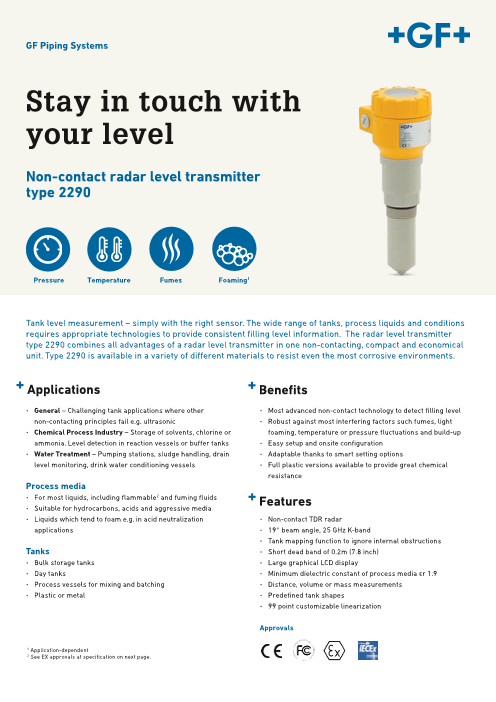
The 25 GHz (K-band) Pulse Radars are the most progressive non-contact level
transmitters for industrial processes. With an excellent accuracy, compact antennas
and a user-friendly set-up the 2290 is an effective, simple, low cost choice for
demanding level applications. GF’s new K-band radar featuring 3 mm (0.1inch)
accuracy and short dead band excels with its robust full plastic housing. Its antenna
range incorporates a stainless steel horn and enclosed plastic tube choices. The
enclosed antenna versions can be replaced without removing the antenna enclosure
from the process. Local programming is aided by a plug-in display module. The
signal processing algorithm of the 2290 is based on years of experience with non-
contact level measurement making it an excellent choice for applications simple and
challenging alike. Process enclosures are available in PTFE, PP & PE.
8.3.2 Radar
With its ability to read accurately when other non-contacting or invasive methods fail,
the guided level transmitter using GWR (guided wave radar) is the solution to your
level needs.
The radar signal is sent down the probe assembly eliminating the interferences
caused by low dielectric liquids, heavy fuming, slightly conductive foams, internal
tank obstructions, etc. By focusing its energy along the probe can be installed in
tanks with limited space. It is also less sensitive to turbulence that would normally
upset the readings in ultrasonic and unguided radar technologies. The probes are
also available as coated options in FEP & PFA.
8.4 Point Level
8.4.1 Point Level Switches
The GF Piping Systems portfolio of point level switches contains various different
detection technologies, to provide a solution for various liquids and application
requirements.
• Vibration Forks detect a liquid level with two vibrating stainless steel wings. In
air they vibrate with a specific, calibrated frequency. By the contact with a
liquid the frequency changes which forces an electrical output to switch. GF
Piping Systems vibration forks are equipped with digital PNP/NPN or relay
output. Versions with ATEX or WHG approval are available.
System Specification SYGEF Plus (PVDF-HP) page 16/ 20
Schaffhausen, June 2018
Page17
- System Specification -
• Conductive Multipoint Switch contains up to 5 stainless steel electrodes, which
allow to detect 4 different liquid levels in a tank. Up to 2 external relay pairs
allow to switch pumps or valves. GF Piping Systems conductive multipoint
switches work with liquids of min. 10µS conductivity. Their four-in-one design
allows fast installation and provides attractive solutions concerning costs.
• Guided Float Switches are equipped with an air filled float with embedded
magnet. Rising liquid lifts up the float. The magnetic field forces a reed contact
to switch. GF Piping Systems guided float switches are available in PP and
PVDF to provide best chemical compatibility to corrosive liquids.
• Ultrasonic Gap Switches are equipped with an ultrasonic transducer and
receiver in their fork tips. Based on the switch design, the sound waves are
damped in air. Thus the output is disabled. In contact with liquid the sound
waves start to travel from transmitter to receiver, which enables the output. GF
Piping Systems ultrasonic gap switches provide an electronic relay output
which allows to control pumps and valves. Thanks to their PPS full-plastic
body they provide a very high resistance against mechanical impacts and
corrosive liquids. They work with no moving parts, so they do not require any
maintenance.
• Float Switches are primarily used in open basins and pump shafts for
detecting liquid level. In an empty tank they hang in vertical position, attached
to the tank wall at their cable. Rising liquid carry them on the liquid surface. At
an angle of approximately 45° an integrated switch is enabled. GF Piping
Systems float switches are double chambered and equipped with a mercury-
fee switch. Hence they may be used for drinking and for waste water
applications.
8.5 Analytic
8.5.1 pH Sensors
All pH sensors are constructed commonly called combination electrodes. The
measuring cell is constructed of hydrogen sensitive glass that can detect the
concentration of hydrogen ions (+H) in a solution. The concentration of +H ions
directly determines the pH of the fluid. The reference cell is used to provide a stable
reference signal. The pH signal is measured against the stable reference signal. The
reference junction allows the reference cell to come in contact with the fluid being
measured. The measured signals are then conditioned and sent as a blind 4-20 mA
or as a digital S3L signal Transmitter.
System Specification SYGEF Plus (PVDF-HP) page 17/ 20
Schaffhausen, June 2018
Page18
- System Specification -
8.5.2 ORP Sensors
All ORP sensors are constructed similar to the pH sensors, except that a noble metal
like platinum or gold replaces the silver chloride element of the measuring and
reference cell of the pH electrode. Temperature compensation is not used in ORP
measurements as well. ORP is an abbreviation for Oxidation-Reduction Potential.
Oxidation is a term used to denote the occurrence of a molecule losing an electron.
Reduction occurs as a molecule gains an electron. The “potential” is simply an
indication of a solution’s propensity to contribute or accept electrons. ORP reactions
(sometimes referred to as REDOX) always take place simultaneously. There is never
oxidation without reduction, and ORP electrodes are used to detect electrons
exchanged by molecules as these reactions occur.
The measured signals are then conditioned and sent as a blind 4-20 mA or as a
digital S3L signal to Transmitter.
8.5.3 Conductivity Sensors
All Conductivity sensors are manufactured using two stainless steel electrodes.
Alternative materials are available in case of chemical incompatibility. Conductivity
sensors measure the ability of a fluid to conduct an electrical current between two
electrodes. The proper term for this ability of a solution is electrolytic conductivity,
since only ions conduct electric current in solution. Electrolytic conductivity (or simply
conductivity) is therefore an indirect measure of the ionic concentration of a solution.
Generally, conductivity increases and decreases with the concentration of ions.
Most conductivity electrodes consist of two measuring half-cells. The geometry of the
half-cells can be tailored to provide highly accurate measurements over a specific
conductivity range. Cell constants help to describe electrode geometry for the
purpose of selecting the appropriate electrode for a given application. A cell constant
is defined as the length between the two halfcells divided by the area of the cells. All
conductivity sensors have a temperature compensation circuits in order to increase
the sensors accuracy.
The measured signals are then conditioned and sent as a blind 4-20 mA or as a
digital S3L signal to the Transmitter.
System Specification SYGEF Plus (PVDF-HP) page 18/ 20
Schaffhausen, June 2018
Page19
- System Specification -
8.6 Multi Parameter Instruments
8.6.1 Transmitters
The Transmitter should provide a single channel interface for many different
parameters including Flow, pH/ORP, Conductivity/Resistivity, Salinity, Pressure,
Temperature, Level and other sensors that output a 4 to 20 mA signal. The display
shows separate lines for units, main and secondary measurements as well as a dial-
type digital bar graph.
The transmitter is offered in both panel or field mount versions. Both configurations
can run on 12 to 32 VDC power (24 VDC nominal). The transmitter can also be loop
powered with compatible sensors.
Derived measurements include difference, sum, ratio, percent recovery, percent
rejection, percent passage and BTU. The menu system can be programmed to
display in multi-languages including English, German, French, Spanish, Italian, and
Portuguese.
• 2,4 or 6 sensor input (Flow, Level, pH-ORP, Conductivity, Pressure
Temperature)
• 0,2 or 4 analogue output (4-20 mA or 0-10 Volts)
• 0,2,4,6 or 8 relay output
• Power supply 12-30 VDC or 110-230 VAC
8.7 Batch Control
A batch controller shall allow batching a pre-selected quantity of liquid. After selection
of the quantity to be dosed, a start signal (local or remote) will close a batch controller
contact to energize or de-energize a valve and/or switch on a pump. The batch
controller count the pulses coming from any sensor with frequency output and stop
the batch process as the pre-selected quantity is reached.
Advanced features include a user-set security code, an automatic calibration option,
and overrun compensation. The batch process is repeatable and is designed for
intensive industrial applications.
System Specification SYGEF Plus (PVDF-HP) page 19/ 20
Schaffhausen, June 2018
Page20
- System Specification -
9. Quality
9.1 Production conditions
SYGEF Plus (PVDF-HP) Pipes, fittings, valves and accessories are manufactured in
an environment operating a Quality Assurance System to ISO 9001 and an
Environmental Management System conform to ISO 14001.
SYGEF Plus (PVDF-HP) products are produced under ISO 14644-1 Class 5 (U.S.
Fed. Standard 2.09E Class 100) conditions. Subsequent quality inspection and
cleaning is to be carried out using 18MΩ pure water under clean room ISO 14644-1
Class 5 (U.S. Fed. Standard 2.09E Class 100) conditions.
9.2 Marking
All components are embossed with a permanent identification during the production
process to ensure full traceability. The following information will be mentioned:
• Manufacturers name or trade mark
• Production lot number
• Material
• Dimension
• Pressure rating
9.3 Uniformity
Pipes, fittings, valves and welding machines shall be supplied from one
manufacturer, namely GF Piping Systems to ensure correct and proper jointing
between components and uniform chemical and physical properties of the piping
system.
9.4 CAD Library
All components shall be available in GF Piping Systems CAD and BIM library.
Available at: http://cad.georgfischer.com & http://bim.gfps.com
9.5 Training, Certification and Installation
Site personnel, involved with SYGEF Plus (PVDF-HP) piping installation shall
undergo training and certification from an authorized local institution prior to
performing any jointing operations on site. For further information and training please
contact GF Piping Systems support under
Contact:
GF Piping Systems Ltd.
Phone: +41 52 631 1111 or
e-mail:info.ps@georgfischer.com
The technical data are not binding. They neither constitute expressly warranted characteristics nor guaranteed
properties nor a guaranteed durability. They are subject to modification. Our General Terms of Sale apply.
System Specification SYGEF Plus (PVDF-HP) page 20/ 20
Schaffhausen, June 2018