



Sea water cooling intake in a power plant
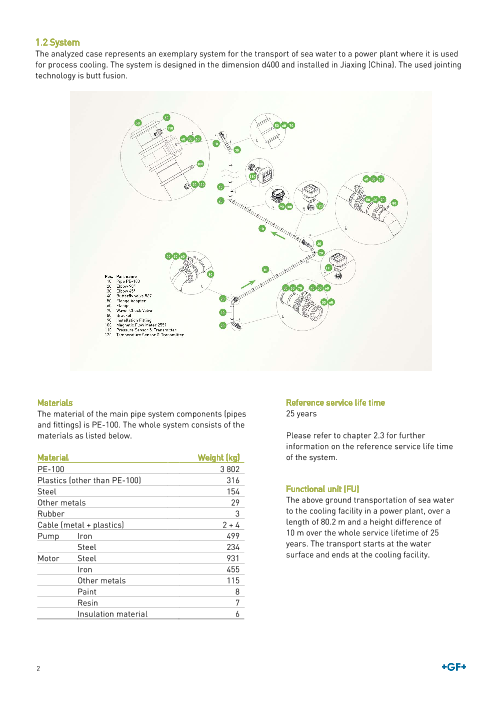
The analyzed case represents an exemplary system for the transport of sea
water to a power plant where it is used for process cooling. The system is
designed in the dimension d400 and installed in Jiaxing (China).
The used jointing technology is butt fusion.
このカタログについて
| ドキュメント名 | Environmental Product Declaration:PE System |
|---|---|
| ドキュメント種別 | 製品カタログ |
| ファイルサイズ | 674.6Kb |
| 取り扱い企業 | ジョージフィッシャー株式会社 (この企業の取り扱いカタログ一覧) |
この企業の関連カタログ


このカタログの内容
Page1
Environmental
Product Declaration
PE-System According to EN 15804
Sea water cooling intake Georg Fischer Piping Systems Ltd. Ebnatstrasse 111
in a power plant CH-8201 Schaffhausen
+41 (0) 52 631 11 11
www.gfps.com/sustainability
1. Declaration of general information sustainability.ps@georgfischer.com
1.1 Introduction
GF Piping Systems is one of the three divisions within Georg Fischer
Corporation and a leading provider of plastic and metal piping systems with
global market presence. The product portfolio includes pipes, fittings,
valves and the corresponding automation and jointing technology for
industry, building technology as well as water and gas utilities. Georg
Fischer Piping Systems proactively incorporates its environmental
responsibility into its everyday business activities. Because we understand
environmental awareness as one of the corporation‘s core values, internal
structures and processes are geared towards sustainability. In this context,
life cycle assessments are the correct tool to gain insight in the different life
cycle phases of our systems.
This EPD is based on a detailed background report written by the Flemish
Institute for technological research (Vito). The report is in line with EN 15804
“Sustainability of construction works – environmental product declarations
– Core rules for the product category of construction products”. The data of
the study complies with the quality requirements set out in EN 15804
(EN 15804+A1:2013, Sustainability of construction works - Environmental
product declarations - Core rules for the product category of construction
products). Data regarding the production of the pipe system components is
company specific and was provided by GF Piping Systems.
Declaration
Declaration owner & Program Georg Fischer Piping
operator’s name Systems Ltd.
Validity 01.06.2014 – 31.05.2019
Declaration Number GFPS-EPD_1405-1_4
EPD-Type Cradle to grave
Data calculated by Vito NV (Flemish Institute for
technological research)
www.vito.be
Life Cycle Inventory (LCI) source Ecoinvent v 2.2 (2010,
for generic background processes updated August 2012)
Software SimaPro 7.3.3
Page2
1.2 System
The analyzed case represents an exemplary system for the transport of sea water to a power plant where it is used
for process cooling. The system is designed in the dimension d400 and installed in Jiaxing (China). The used jointing
technology is butt fusion.
Materials Reference service life time
The material of the main pipe system components (pipes 25 years
and fittings) is PE-100. The whole system consists of the
materials as listed below. Please refer to chapter 2.3 for further
information on the reference service life time
Material Weight (kg) of the system.
PE-100 3 802
Plastics (other than PE-100) 316
Steel 154 Functional unit (FU)
Other metals 29 The above ground transportation of sea water
Rubber 3 to the cooling facility in a power plant, over a
Cable (metal + plastics) 2 + 4 length of 80.2 m and a height difference of
Pump Iron 499 10 m over the whole service lifetime of 25
Steel 234 years. The transport starts at the water
Motor Steel 931 surface and ends at the cooling facility.
Iron 455
Other metals 115
Paint 8
Resin 7
Insulation material 6
2
Page3
Components of the system (number of pieces or meter)
The system mainly consists of Georg Fischer Piping Systems components. However, to complete the system also
external components (Ext.) are necessary which are not produced by Georg Fischer Piping Systems. The calculation
of the environmental impact of these products is based on publicly available data and assumptions.
Product Code Pieces or meter Material
System components
PE pipe, d400 193017175 80.2 m PE-100
Bend 90°, d400 753021025 4 PE-100
Bend 45°, d400 753051025 2 PE-100
Flange adapters, d400 753800025 16 PE-100
Installation fittings, d400 – d630 753314002 3 PE-100
Backing flanges, d400 727700525 16 PPGF30
Butterfly valve type 567 (with pneumatic 167567052 4 PP-H (body) and others
actuator), d400
Wafer check valve type 369, d400 Custom made 3 PP-H (body) and others
item
2551 Magmeter flow sensor 159001112 2 PP (sensor body) and others
Level/pressure integral system 159001041 2 PVDF (sensor housing) and
others
2350 Temperature sensor 159000920 1 PVDF (sensor housing) and
others
9900 Transmitter 159001696 1 PBT (housing) and others
Cable Ext. 120 m Copper and others
Pump Ext. 1 Various metals and others
Motor Ext. 1 Various metals and others
Components for installation
Bolts Ext. 64 Stainless steel
Nuts Ext. 128 Stainless steel
Washers Ext. 128 Stainless steel
Brackets Ext. 32 PP
1.3 Comparability
EPDs of construction products may not be comparable if they do not comply with the EN 15804.
1.4 Demonstration of verification
3
Page4
2. Declaration of environmental parameters derived from LCA
2.1 Flow diagram of the processes included in the LCA
Product stage Use stage
End of life A1: Raw material supply B1: Use *
stage A2: Transport B2: Maintenance ** C1: De-
A3: Manufacturing B3: Repair ** construction/
Construction-installation A B4: Replacement ** B Demolition ** C
process B5: Refurbishment ** C2: Transport
A4: Transport to installation B6: Operational C3: Waste
A5: Installation energy use processing
B7: Operational water C4: Disposal
use *
* Stage not relevant, ** Environmental impact below cut-off criteria. Please refer to chapter 2.3 for details.
2.2 Parameters describing environmental impacts
Photo- Abiotic
Acidificatio chemical depletion Abiotic
Global Ozone n of soil Eutro- ozone - non depletion
Impact category warming depletion and water phication creation fossil - fossil
kg CO2 eq kg CFC-11 eq kg SO2 eq kg PO
3-
4 eq kg C2H4 eq kg Sb eq MJ
A1-3 Product stage 1.92E+04 5.72E-03 1.04E+02 1.59E+01 7.22E+00 5.83E-01 4.09E+05
Transport to
A4 6.38E+03 8.17E-04 2.54E+01 4.45E+00 1.03E+00 3.34E-03 8.82E+04
installation
A5 Installation 2.47E+02 3.37E-06 1.07E+00 1.41E-01 7.84E-02 2.11E-04 1.51E+03
Use, Maintenance,
Repair, Replace-
B1-5 0 0 0 0 0 0 0
ment, Refurbish-
ment
Operational energy
B6 1.19E+07 6.77E-02 1.03E+05 5.55E+03 4.45E+03 2.36E+00 9.80E+07
use
Operational water
B7 0 0 0 0 0 0 0
use
De-construction/
C1 0 0 0 0 0 0 0
Demolition
Transport to end-
C2 2.85E+02 4.42E-05 1.07E+00 2.07E-01 3.65E-02 2.17E-03 4.15E+03
of-life treatment
C3 Waste processing 0 0 0 0 0 0 0
C4 Disposal 4.61E+02 1.28E-05 3.09E-01 1.21E-01 8.88E-02 1.19E-04 1.16E+03
4
Page5
2.3 Scenarios and additional technical information
The analyzed case represents an exemplary system for the transport of sea water to a power plant where it is used for process
cooling.
Product stage
The production of the plastic raw material was modeled by generic European data (source: ecoinvent) and
A1 complemented by specific data from GF Piping Systems to consider the company specific formulation of the raw
material.
Wherever possible, the specific transport distances were taken into account. Data from ecoinvent with the
A2
respective parameters was used to model the transportation.
The use of energy is the most important input for this process step. Pipes are extruded while fittings and valve
parts are injection moulded. Each of GF Piping Systems’ worldwide production sites is certified according to ISO
14001 (Environmental management systems) and to OHSAS 18001 (Occupational health and safety management
A3
systems) or is currently in the certification process. For the production of GF Piping Systems components,
electricity mixes for the respective country/continent were used. The production of external products was modeled
using generic ecoinvent data records for the process.
Construction process
The system is installed in Jiaxing (near Shanghai), China.
Pipes, bends 90° and flange adapters, brackets as well as bolts, nuts and washers are transported over a distance
of 127 km by means of a truck directly to the installation site. Measuring instruments are transported by air freight
(10 885 km) and truck (127 km) to the installation site. The other components are first transported by truck to
A4 storage: Installation fittings (150 km), backing flanges (560 km), bends 45° (130 km), butterfly valves
(456 km), check valves (250 km), brackets (700 km). Afterwards they are transported by air (9 262 km) and truck
(127 km) to the installation site.
For all transportations by truck the ecoinvent data record “Transport, lorry > 16t, fleet average/RER U” was used.
Loading capacity is 60%.
For the installation of the whole system 72 kWh welding energy (Chinese electricity mix) is needed. Furthermore,
specific cleaner (0.2 kg/FU) is necessary. The cleaner is transported by truck (1 027 km) and air freight (9 262 km)
to the installation site.
A5
Outputs of the complete installation of the system are PE pipe left over (5 kg/FU) and packaging waste
(118 kg/FU) whereof 77% is cardboard. All waste is going to landfill. Transport distance to landfill is assumed to be
200 km. Transport is carried out by truck.
Use stage
There are no further environmental impacts arising from the use of the system. This stage is considered as not
B1
relevant.
The system is designed to be operated without repair, maintenance, replacement or refurbishment during the
reference service life time. This is subject to the condition that the system is operated according to the
specifications given by GF Piping Systems.
B2-B5 The lifetime of a valve is mainly influenced by the actuation cycles. The number of actuation cycles the valves are
tested for is not reached during the life time of the evaluated system. It is possible that in individual cases
components of the valve (e.g. seals) must be replaced. In this case the environmental impact is negligible
compared to the impact of the whole system and below the cut-off criteria defined in EN 15804.
The operational energy use of the system is an important stage because of the long reference service life time of
B6 25 years. 10 082 200 kWh of energy (ecoinvent dataset: Electricity, medium voltage, at grid/CN U) for the pump
during the use stage is necessary per functional unit.
B7 No operational water use is necessary for the system. This stage is considered as not relevant.
End of life stage
A small energy input is needed to cut the pipe into smaller pieces. The environmental impact is negligible
C1
compared to the impact of the whole system and below the cut-off criteria defined in EN 15804.
Transportation to the end of life treatment facilities is carried out by truck. Distances to recycling and landfill are
C2
200 km.
C3 All metal parts of the system – in total 2 419 kg - are recycled.
C4 All other parts – in total 4 146 kg - are going to landfill.
5
Page6
Reference service life data
Parameter Data
Reference Service Life 25 years
System components are compliant with relevant international standards, e.g.
• EN (European Standards)
• ISO (International Organization for Standardization)
• BS (British Standard)
• ASTM (American Society for Testing and Materials)
• JIS (Japan Industrial Standard)
Declared product
Most relevant standards are:
properties
ISO 15494 Plastics piping systems for industrial applications - Polybutene (PB),
Polyethylene (PE) and Polypropylene (PP) - Specifications for
components and the system
ISO 16136 Industrial valves - Butterfly valves of thermoplastics materials
ISO 16137 Industrial valves - Check valves of thermoplastics materials
EN 12201 Plastics piping systems for water supply, and for drainage and
sewerage under pressure - Polyethylene (PE)
PE-100 characteristics Value Test standard
Operating temperature range -50 °C to + 60 °C
UV resistant yes
Density 0.95 g/cm3 EN ISO 1183 - 1
Yield stress at 23 °C 25 N/mm2 EN ISO 527 - 1
Tensile e-modulus at 23 °C 900 N/mm2 EN ISO 527 - 1
Charpy notched impact strength at 23 °C 83 kJ/m2 EN ISO 179 – 1/1eA
Design application Charpy notched impact strength at -40 °C 13 kJ/m2 EN ISO 179 – 1/1eA
parameters Ball indentation hardness (132 N) 37 MPa EN ISO 2039 - 1
Crystallite melting point 130 °C DIN 51007
Heat conductivity at 23 °C 0.38 W/m K EN 12664
Water absorption at 23 °C 0.01-0.04% EN ISO 62
For more information, please refer to the planning fundamentals which are available at:
gfps.com > support & services > Planning Assistance > Planning Fundamentals > Industrial Piping
Systems
• Constant water supply without interrupting operations
• Leakproof system reduces water losses
Assumed quality of work
• Flexibility of plastics pipes minimizes the risk of water hammer
• No corrosion and no incrustation reduces maintenance to a minimum
The system is installed in Jiaxing (near Shanghai) where the following outdoor parameters apply:
Average air temperature: 17°C
Outdoor environment Average water temperature: 17°C
Average hours of sunshine/day: 5h
• SDR 11
• PN 16
Usage conditions
• Flow rate 2.5 m/s
The system is designed to be operated without repair, maintenance, replacement or
refurbishment. This is subject to the condition that the system is installed and operated according
Maintenance
to the specifications given by GF Piping Systems. Please refer also to chapter 2.3.
6
Page7
2.4 Parameters describing resource use
Product Construction
Parameters describing resource use, primary energy Use stage End of life
stage process stage
A1-3 A4 A5 B1-B5 B6 B7 C1 C2 C3 C4
Use of renewable primary energy excluding
renewable primary energy resources used as raw 2.22E+04 4.12E+02 7.98E+01 0 7.32E+06 0 0 8.69E+01 0 2.14E+01
materials
Use of renewable primary energy resources used as
3.55E+02 0 0 0 0 0 0 0 0 0
raw materials
Total use of renewable primary energy resources
(primary energy and primary energy resources used 2.26E+04 4.12E+02 7.98E+01 0 7.32E+06 0 0 8.69E+01 0 2.14E+01
as raw materials)
Use of non-renewable primary energy excluding non-
renewable primary energy resources used as raw 2.78E+05 9.03E+04 1.34E+03 0 1.01E+08 0 0 4.55E+03 0 1.26E+03
materials
Use of non-renewable primary energy resources
1.72E+05 0 2.59E+02 0 0 0 0 0 0 0
used as raw materials
Total use of non-renewable primary energy
resources (primary energy and primary energy 4.51E+05 9.03E+04 1.59E+03 0 1.01E+08 0 0 4.55E+03 0 1.26E+03
resources used as raw materials)
Parameters describing resource use, secondary Product Construction
materials and fuels, and use of water Use stage End of life stage process stage
A1-3 A4 A5 B1-B5 B6 B7 C1 C2 C3 C4
Use of secondary material* kg 1.46E-02 0 0 0 0 0 0 0 0 0
Use of renewable secondary
MJ, net calorific value 0 0 0 0 0 0 0 0 0 0
fuels*
Use of non-renewable
MJ, net calorific value 0 0 0 0 0 0 0 0 0 0
secondary fuels*
Net use of fresh water m3 2.94E+04 9.69E+00 4.31E-01 0 2.92E+04 0 0 1.19E+00 0 1.20E+00
*Only for foreground process from which LCI data are made available by GF Piping Systems - the number does not include processes and materials modelled by
means of background data, e.g. transportation, electricity, ancillary materials, etc.
7
MJ, net calorific value
Total (of product stage) Total (of product stage)
Transport Transport
Construction installation Construction installation
process process
Use , Maintenance, Repair, Use, Maintenance, Repair,
Replacement, Refurbishment Replacement, Refurbishment
Operational energy use Operational energy use
Operational water use Operational water use
De-construction / Demolition De-construction / Demolition
Transport Transport
Waste processing Waste processing
Disposal Disposal
Page8
2.5 Environmental information describing output flows
Other environmental information describing output Product Construction Use stage End of life
flows stage process stage
A1-3 A4 A5 B1-B5 B6 B7 C1 C2 C3 C4
Components for re-use* kg 0 0 0 0 0 0 0 0 0 0
Materials for recycling* kg 4.15E+01 0 0 0 0 0 0 0 0 2.42E+03
Materials for energy recovery* kg 0 0 0 0 0 0 0 0 0 0
MJ per energy
Exported energy - electricity* 3.67E-01 0 0 0 0 0 0 0 0 0
carrier
Exported energy - thermal MJ per energy
7.75E-01 0 0 0 0 0 0 0 0 0
energy* carrier
*Only for foreground process from which LCI data are made available by GF Piping Systems - the number does not include processes and materials modelled by
means of background data, e.g. transportation, electricity, ancillary materials, etc.
Other environmental information describing waste Product Construction
Use stage End of life
categories stage process stage
A1-3 A4 A5 B1-B5 B6 B7 C1 C2 C3 C4
Hazardous waste disposed 1.35E+01 4.24E-02 3.87E-04 0 1.19E+01 0 0 5.21E-03 0 6.01E-04
Non-hazardous waste disposed kg 7.99E+05 7.90E+01 1.32E+02 0 7.81E+05 0 0 2.72E+01 0 4.16E+03
Radioactive waste disposed 3.14E+01 2.94E-02 7.09E-04 0 3.08E+01 0 0 5.44E-03 0 1.30E-03
8
Total (of product stage) Total (of product stage)
Transport Transport
Construction installation Construction installation
process process
Use , Maintenance, Repair, Use, Maintenance, Repair,
Replacement, Refurbishment Replacement, Refurbishment
Operational energy use Operational energy use
Operational water use Operational water use
De-construction/ Demolition De-construction / Demolition
Transport Transport
Waste processing Waste processing
Disposal Disposal
Page9
9