Download this catalog and see all




Document Information
| Document Title | G7SA Data Sheet |
|---|---|
| Document Type | Product Catalog |
| File size | 2.4Mb |
| Category | |
| Company | OMRON Corporation (Documents List) |
Documents related to this company



Document Contents
Page1
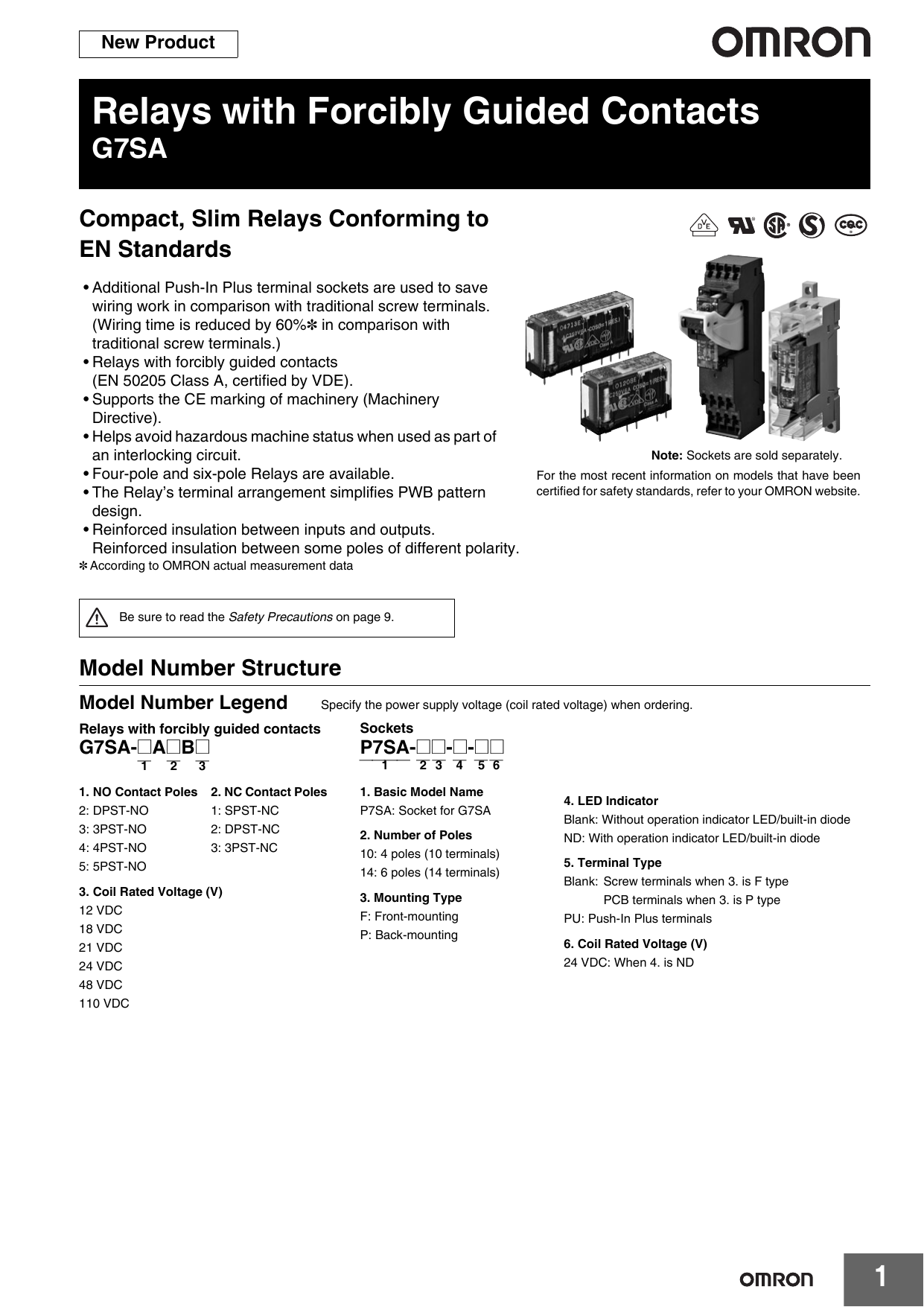
New Product
Relays with Forcibly Guided Contacts
G7SA
Compact, Slim Relays Conforming to
EN Standards
• Additional Push-In Plus terminal sockets are used to save
wiring work in comparison with traditional screw terminals.
(Wiring time is reduced by 60%* in comparison with
traditional screw terminals.)
• Relays with forcibly guided contacts
(EN 50205 Class A, certified by VDE).
• Supports the CE marking of machinery (Machinery
Directive).
• Helps avoid hazardous machine status when used as part of
an interlocking circuit. Note: Sockets are sold separately.
• Four-pole and six-pole Relays are available. For the most recent information on models that have been
• The Relay’s terminal arrangement simplifies PWB pattern certified for safety standards, refer to your OMRON website.
design.
• Reinforced insulation between inputs and outputs.
Reinforced insulation between some poles of different polarity.
* According to OMRON actual measurement data
Be sure to read the Safety Precautions on page 9.
Model Number Structure
Model Number Legend Specify the power supply voltage (coil rated voltage) when ordering.
Relays with forcibly guided contacts Sockets
G7SA-@A@B@ P7SA-@@-@-@@
⎯1 ⎯2 ⎯3 ⎯⎯1⎯ ⎯ ⎯2 ⎯3 ⎯4 ⎯5 ⎯6
1. NO Contact Poles 2. NC Contact Poles 1. Basic Model Name
4. LED Indicator
2: DPST-NO 1: SPST-NC P7SA: Socket for G7SA
Blank: Without operation indicator LED/built-in diode
3: 3PST-NO 2: DPST-NC 2. Number of Poles ND: With operation indicator LED/built-in diode
4: 4PST-NO 3: 3PST-NC 10: 4 poles (10 terminals)
5: 5PST-NO 5. Terminal Type
14: 6 poles (14 terminals)
Blank: Screw terminals when 3. is F type
3. Coil Rated Voltage (V) 3. Mounting Type PCB terminals when 3. is P type
12 VDC F: Front-mounting PU: Push-In Plus terminals
18 VDC P: Back-mounting
21 VDC 6. Coil Rated Voltage (V)
24 VDC 24 VDC: When 4. is ND
48 VDC
110 VDC
1
Page2
G7SA
Ordering Information
Specify the coil rated voltage when ordering.
Relays with Forcibly Guided Contacts
Type Sealing Poles Contact configuration Coil rated voltage Model
3PST-NO, SPST-NC 12, 18, 21, 24, 48, 110 VDC G7SA-3A1B
4 poles
DPST-NO, DPST-NC 12, 18, 21, 24, 48, 110 VDC G7SA-2A2B
Standard Flux-tight 5PST-NO, SPST-NC 12, 18, 21, 24, 48, 110 VDC G7SA-5A1B
6 poles 4PST-NO, DPST-NC 12, 18, 21, 24, 48, 110 VDC G7SA-4A2B
3PST-NO, 3PST-NC 12, 18, 21, 24, 48, 110 VDC G7SA-3A3B
Sockets
Mounting Terminal Type LED
Indicator Poles Coil rated voltage Model
4 poles P7SA-10F-ND-PU
Push-In Plus terminals Yes
6 poles P7SA-14F-ND-PU
24 VDC
4 poles P7SA-10F-ND
Front-mounting Yes
6 poles P7SA-14F-ND
Screw terminals
4 poles P7SA-10F
No
6 poles P7SA-14F
4 poles P7SA-10P
Back-mounting PCB terminals No
6 poles P7SA-14P
Accessories (Order Separately)
Short Bars (For P7SA-@F-ND-PU)
Pitch No. of poles Colors Model*1*2
2 XW5S-P2.5-2@
3 Red (RD) XW5S-P2.5-3@
5.2 mm Blue (BL)
4 Yellow (YL) XW5S-P2.5-4@
5 XW5S-P2.5-5@
Note: Use for crossover wiring of adjacent contact terminals (bottom) within one Socket.
*1. Replace the box (@) in the model number with the code for the covering color. Color Options: RD = red, BL = blue, YL = yellow
Example: XW5S-P2.5-10RD when the covering color is red.
*2. XW5S-P2.5-5@ cannot be used with P7SA-10F-ND-PU.
Parts for DIN Track Mounting
Type Model Minimum Order
(quantity)
1 m PFP-100N
DIN Tracks 1
0.5 m PFP-50N
End Plate * PFP-M
10
Spacer PFP-S
Refer to your OMRON website for details on the PFP-@.
* When mounting DIN track, please use End Plate (Model PFP-M).
2
Page3
G7SA
Specifications
Ratings
Coil (4 poles) Contacts
Item Rated Coil Max. Power Item Load Resistive load
current resistance voltage consumption Rated load 6 A at 250 VAC, 6 A at 30 VDC
Rated voltage (mA) () (V) (mW) Rated carry current 6 A
12 VDC 30 400 Max. switching voltage 250 VAC, 125 VDC
18 VDC 20 900 Max. switching current 6 A
21 VDC 17.1 1,225 Approx. 360
110% Contact materials Au plating + Ag alloy
24 VDC 15 1,600
48 VDC 7.5 6,400
110 VDC 3.8 28,810 Approx. 420
Coil (6 poles)
Item Rated Coil Max. Power
current resistance voltage consumption
Rated voltage (mA) () (V) (mW)
12 VDC 41.7 288
18 VDC 27.8 648
21 VDC 23.8 882 Approx. 500
110%
24 VDC 20.8 1,152
48 VDC 10.4 4,606
110 VDC 5.3 20,862 Approx. 580
Note: 1. The rated current and coil resistance are measured at a coil
temperature of 23°C with tolerances of ±15%.
2. The maximum voltage is based on an ambient operating
temperature of 23°C maximum.
Characteristics
Contact resistance *1 100 m max.
Operating time *2 20 ms max.
Response time *3 10 ms max.
Release time *2 20 ms max.
Must operate voltage 75% max.
Must release voltage 10% min.
Maximum operating Mechanical 36,000 operations/h
frequency Rated load 1,800 operations/h
Insulation resistance *4 1,000 M min.
Between coil and
contacts 4,000 VAC, 50/60 Hz for 1 min.
Dielectric Strength Between 4,000 VAC, 50/60 Hz for 1 min. (except for followings)
*5 *6 contacts of 4 poles (for poles 3-4 in 4-pole Relays),
different polarity 6 poles (for poles 3-5, 4-6, and 5-6 in 6-pole Relays): 2,500 VAC, 50/60 Hz for 1 min.
Between contacts
of the same polarity 1,500 VAC, 50/60 Hz for 1 min.
Vibration resistance 10 to 55 to 10 Hz, 0.75-mm single amplitude (1.5-mm double amplitude)
Destruction 1,000 m/s2
Shock resistance
Malfunction 100 m/s2
Mechanical 10,000,000 operations min. (at approx. 36,000 operations/h)
Durability *7
Electrical 100,000 operations min. (at the rated load and approx. 1,800 operations/h)
Inductive load switching capability *8 AC15 AC240V 2A
(IEC60947-5-1) DC13 DC24V 1A
Failure rate (P level)
(reference value *9) 5 VDC, 1 mA
Ambient operating temperature *10 12 to 48 VDC: -40 to 85°C (with no icing or condensation)
110 VDC: -40 to 60°C (with no icing or condensation)
Ambient operating humidity 5% to 85% RH
Weight 4 poles: Approx. 22 g
6 poles: Approx. 25 g
Note: 1. The above values are initial values.
2. Performance characteristics are based on coil temperature of 23°C.
*1. The contact resistance was measured with 1 A at 5 VDC using the voltage-drop method.
*2. These times were measured at the rated voltage and an ambient temperature of 23°C. Contact bounce time is not included.
*3. The response time is the time it takes for the normally open contacts to open after the coil voltage is turned OFF. Contact bounce time is
included. Measurement conditions: Rated voltage operation, Ambient temperature: 23°C
*4. The insulation resistance was measured with a 500-VDC megohmmeter at the same locations as the dielectric strength was measured.
*5. Pole 3 refers to terminals 31-32 or 33-34, pole 4 refers to terminals 43-44, pole 5 refers to terminals 53-54, and pole 6 refers to terminals 63-64.
*6. When using a P7SA Socket, the dielectric strength between coil contacts/different poles is 2,500 VAC, 50/60 Hz for 1 min. When using Push-
In Plus terminal sockets (P7SA-@F-ND-PU), the dielectric strength between coil contacts as well as between different poles is 4,000 VAC, 50/
60 Hz for 1 min.
*7. The durability is for an ambient temperature of 15 to 35°C and an ambient humidity of 25% to 75%. For the durability performance to the load,
refer to the Durability Curve.
*8. AC15: cos = 0.3, DC13: L/R = 48-ms.
*9. The failure rate is based on an operating frequency of 300 operations/min.
*10. 12 to 48 VDC: When operating between 70 and 85°C, reduce the rated carry current of 6 A by 0.1 A for each degree above 70°C.
110 VDC: When operating between 40 and 60°C, reduce the rated carry current of 6 A by 0.27 A for each degree above 40°C.
3
Page4
G7SA
Characteristics of Sockets
Push-In Plus terminals Screw terminals PCB terminals
4 poles 6 poles 4 poles 6 poles 4 poles 6 poles
Items Models P7SA-10F-ND-PU P7SA-14F-ND-PU P7SA-10F(-ND) P7SA-14F(-ND) P7SA-10P P7SA-14P
• With operation indicator LED/built-in diode
P7SA-@F-ND(-PU): 20 to +70°C
Ambient operating temperature • Without operation indicator LED/built-in diode 40 to +85°C
P7SA-@F: 40 to +85°C (with no icing or condensation)
(with no icing or condensation)
Ambient operating humidity 25 to 85% RH 5 to 85% RH
Continuous carry current 6 A *1
Between coil and
contact terminals 4,000 VAC for 1 min.
Between contact 2,500 VAC for 1 min.
Dielectric terminals of different 2,500 VAC for 1 min.
strength polarity
Between contact
terminals of same 1,500 VAC for 1 min.
polarity
Insulation resistance 1,000 M min. *2
Weight Approx. 58 g Approx. 70 g Approx. 44 g Approx. 59 g Approx. 9 g Approx. 10 g
*1. When operating the P7SA-@F-ND-PU at a temperature between 50 and 70°C, reduce the continuous current (6 A at 50°C or less) by 0.25 A
for each degree above 50°C.
When operating the P7SA-@F-ND at a temperature between 50 and 70°C, reduce the continuous current (6 A at 50°C or less) by 0.3 A for
each degree above 50°C.
When operating the P7SA-@F at a temperature between 50 and 85°C, reduce the continuous current (6 A at 50°C or less) by 0.1 A for each
degree above 50°C.
*2. Measurement conditions: For 500 VDC applied to the same location as for dielectric strength measurement.
Engineering Data
Durability Curve
G7SA-@A@B
1,000
700
500 DC1, 24 VDC
300
AC1, 240 VAC
100
70
50
DC13, 24 VDC
30
AC15, 240 VAC
10
7
5
3
1
0.1 0.3 0.5 0.7 1 3 5 7 10
Contact current (A)
Ambient temperature and contact current
P7SA-@F-ND-PU P7SA-@F-ND
P7SA-@F
Total*1 Total*2 1 circuit
-10F -14F 7 7
P7SA-@F
24 15 20 6 6
20 12.6 17 5 5
16 10.2 14 4 4
12 7.8 11 3 3 P7SA-@F-ND
8 5.4 8 2 2
4 3 5 1 1
0 0 0 0 0
-20 -10 0 10 20 30 40 50 60 70 80 -40 -30 -20 -10 0 10 20 30 40 50 60 70 80 90
Ambient temperature (°C) Ambient temperature (°C)
*1. When using a G7SA-5A1B relay, be careful not to exceed the total current (24 A).
(Example: at 50°C, 5 contacts × 4.8 A)
*2. Certification conditions for the TÜV certification. Care should be taken not to exceed the total current.
4
Contact current (A) No. of operations (× 104 operations)
Contact current (A)
Page5
G7SA
Dimensions (Unit: mm)
Relays with Forcibly Guided Contacts
4 poles Terminal Arrangement/ Printed Circuit Board
G7SA-3A1B Internal Connection Diagram Design Diagram
G7SA-2A2B (Bottom View) (Bottom View)
(±0.1 tolerance)
G7SA-3A1B
13 max.
40 max. 0 11 12 33 34
Ten, 1.4 dia.
+
24 max. - 10.16
0.5
1 23 24 43 44
(1.83) 13.97 11.43
5.08 5.08
0.5 1 3.5
G7SA-2A2B Note: 1. Terminals 23-24, 33-34,
0 11 12 33 34 and 43-44 are normally
open. Terminals 11-12 and
+ 21-22 are normally closed.
- 2. The colors of the cards
inside the Relays are as
1 21 22 43 44 follows: G7SA-3A1B: Blue
and G7SA-2A2B: White.
6 poles
G7SA-5A1B Terminal Arrangement/ Printed Circuit Board
G7SA-4A2B Internal Connection Diagram Design Diagram
(Bottom View) (Bottom View)
G7SA-3A3B (±0.1 tolerance)
G7SA-5A1B
0 11 12 33 34 53 54
Fourteen, 1.4 dia.
+
13 max. - 10.16
50 max.
1 23 24 43 44 63 64 (1.83) 13.97 11.43
5.08 5.08 5.08 5.08
24 max.
0.5 G7SA-4A2B
0 11 12 33 34 53 54
0.5 1 3.5 +
- Note: 1. Terminals 23-24, 33-34,
1 21 22 43 44 63 64 43-44, 53-54, and 63-64
are normally open.
Terminals 11-12, 21-22,
G7SA-3A3B and 31-32 are normally
closed.
0 11 12 31 32 53 54 2. The colors of the cards
+ inside the Relays are as
follows: G7SA-5A1B: Blue,
-
G7SA-4A2B: White, and
1 21 22 43 44 63 64 G7SA-3A3B: Yellow.
5
Page6
G7SA
Sockets
Front-mounting Sockets
Push-In Plus terminals 4 poles Terminals Arrangement/Internal Connections Diagram (Top View)
P7SA-10F-ND-PU G7SA-3A1B Mounted G7SA-2A2B Mounted
A1 (0) A2 (1) A1 (0) A2 (1)
3.4
61
LED indicator 35.4
100
12 34 44 24 12 34 44 22
11 33 43 23 11 33 43 21
4.5
22.5 35.4
(4)
Note: 1. The numbers in parentheses are traditionally used terminal numbers.
2. Terminals 23-24, 33-34, and 43-44 are normally open. Terminals 11-12
and 21-22 are normally closed.
Push-In Plus terminals 6 poles
P7SA-14F-ND-PU Terminals Arrangement/Internal Connections Diagram (Top View)
G7SA-5A1B Mounted G7SA-4A2B Mounted G7SA-3A3B Mounted
A1 (0) A2 (1) A1 (0) A2 (1) A1 (0) A2 (1)
3.4
LED indicator 61
35.4
12 12 12
11 11 11
100
24 34 44 54 64 22 34 44 54 64 22 32 44 54 64
23 33 43 53 63 21 33 43 53 63 21 31 43 53 63
4.5
27.7 35.4
(4)
Note: 1. The numbers in parentheses are traditionally used terminal numbers.
2. Terminals 23-24, 33-34, 43-44, 53-54, and 63-64 are normally open.
Terminals 11-12, 21-22, and 31-32 are normally closed.
Accessories (Order Separately)
Short Bars (for P7SA-@F-ND-PU)
XW5S-P2.5-@@
5.2 × (No. of poles −1) +3.7 3 Maximum
Application Pitch Compatible models No. of
poles P (mm) Colors Model * carry
current
2 5.2 XW5S-P2.5-2@
For Red (RD)
Contact 3 10.4 Blue (BL) XW5S-P2.5-3@
terminals 5.2 mm For P7SA-@F-ND-PU
23 4 15.6 Yellow 24 A
XW5S-P2.5-4@
(bottom) (YL)
5 20.8 XW5S-P2.5-5@
Note: Use for crossover wiring of adjacent contact terminals (bottom) within one Socket.
* Replace the box (@) in the model number with the code for the covering color.
Color Options: RD = red, BL = blue, YL = yellow
1.6
5.2
P
6
Page7
G7SA
Front-mounting Sockets Terminal Arrangement/Internal Connection Diagram (Top View)
Screw terminals 4 poles G7SA-3A1B Mounted G7SA-2A2B Mounted
P7SA-10F, P7SA-10F-ND
44 33 34 44 33 34
43 43
24 22
* *
23 21
12 12
11 1 0 11 1 0
The above figure shows with the finger cover mounted.
* This display circuit is available only for "-ND" models.
2R 22.5 max. 60.5 max. Note: Terminals 23-24, 33-34, and 43-44 are normally open.
Ten, Terminals 11-12 and 21-22 are normally closed.
9 max. 5 M3×8
Mounting Hole Placement Diagram (Top View)
Two, 4 dia. 14.5±0.2
or M3.5
72 max.
LED
indicator
80±0.2
9 max.
4 dia.
Note 1: The front view shows with the finger cover removed.
2: Only the -ND Sockets have LED indicators (orange)
Screw terminals 6 poles Terminal Arrangement/Internal Connection Diagram (Top View)
P7SA-14F, P7SA-14F-ND G7SA-5A1B G7SA-4A2B G7SA-3A3B
Mounted Mounted Mounted
64 54 64 54 64 54
63 53 63 53 63 53
44 34 44 34 44 32
* * *
43 33 43 33 43 31
24 12 22 12 22 12
23 1 0 11 21 1 0 11 21 1 0 11
The above figure shows with the finger cover mounted.
* This display circuit is available only for "-ND" models.
2R 30 max. 60.5 max. Note: Terminals 23-24, 33-34, 43-44, 53-54, and 63-64 are normally
Fourteen, open. Terminals 11-12, 21-22, and 31-32 are normally closed.
9 max. 5 M3 × 8 Mounting Hole Placement Diagram (Top View)
Two, 4 dia. 22±0.2
or M3.5
72 max.
LED
indicator
80±0.2
9 max.
4 dia.
Note 1: The front view shows with the finger cover removed.
2: Only the -ND Sockets have LED indicators (orange).
Accessories (Order Separately)
Parts for DIN Track Mounting
Refer to your OMRON website for details about PFP-@.
7
Page8
G7SA
Back-mounting Sockets (for PCB)
PCB terminals 4 poles
P7SA-10P
0.5 50 max. 0.5
Terminal Arrangement/Internal Mounting Hole Placement
15 max. Connection Diagram (Bottom View)
(Bottom View) (±0.1 tolerance)
G7SA-3A1B Mounted
0 11 12 33 34
+ Three, 3.2 dia.
- 39.9±0.2 (for M3 tapping
41.5 max.
1 23 24 43 44 4.1±0.2 24.8±0.2 screws)
G7SA-2A2B Mounted 10.16
0 11 12 33 34
+ 13.97 11.43
3.5 (7.14) Ten, 1.1 dia.
(11.1) 0.4 (11.1) 0.8 - 5.08 5.08
Three, 2.6 dia. 1 21 22 43 44
(for M3 tapping screws)
Note: Terminals 23-24, 33-34, and 43-44
are normally open. Terminals 11-12
4.1 24.8 and 21-22 are normally closed.
39.9
PCB terminals 6 poles
P7SA-14P
0.5 60 max. 0.5 Terminal Arrangement/ Mounting Hole Placement
Internal Connection (Bottom View)
15 max. Diagram (Bottom View) (±0.1 tolerance)
G7SA-5A1B Mounted
0 11 12 33 34 53 54
+ Three, 3.2 dia.
49.9±0.2
- (for M3 tapping
4.1±0.2 24.8±0.2 Fourteen, screws)
41.5 max. 1 23 24 43 44 63 64 1.1 dia.
G7SA-4A2B Mounted 10.16
0 11 12 33 34 53 54
13.97 11.43
+ (7.14)
5.08 5.08 5.08 5.08
0.4 3.5 -
(11.1) (11.1) 0.8
1 21 22 43 44 63 64
Three, 2.6 dia.
(for M3 tapping screws) G7SA-3A3B Mounted
Note: Terminals 23-24, 33-34, 43-44,
0 11 12 31 32 53 54 53-54, and 63-64 are normally
+ open. Terminals 11-12, 21-22,
4.1 24.8 - and 31-32 are normally closed.
49.9 1 21 22 43 44 63 64
Certified Standards
Relays with forcibly guided contacts Sockets
G7SA Screw terminals / PCB terminals
• EN Standards, VDE Certified P7SA-@F-ND / P7SA-@P
EN 61810-1 (Electromechanical non-specified time all-or-nothing • EN Standards, VDE Certified
relays) EN 61984
EN 50205 (Relays with forcibly guided (linked) contacts) • UL standard UL508 Industrial Control Devices
• UL standard UL508 Industrial Control Devices • CSA standard CSA C22.2 No. 14 Industrial Control Devices
• CSA standard CSA C22.2 No. 14 Industrial Control Devices Push-In Plus terminals
• South Korea S-mark certified (Rated voltage 24VDC only) P7SA-@F-ND-PU
KS C IEC 61810-1 • EN Standards, TÜV Certified
EN 50205 EN 61984
• CQC GB/T 21711.1 • UL standard UL 508 Industrial Control Devices
• CSA standard CSA C22.2 No.14 Industrial Control Devices
Forcibly Guided Contacts (from EN 50205)
If an NO contact becomes welded, all NC contacts will maintain a minimum distance of 0.5 mm when the coil is not energized. Likewise if an NC
contact becomes welded, all NO contacts will maintain a minimum distance of 0.5 mm when the coil is energized.
8
Page9
G7SA
Safety Precautions
Be sure to read the Common Precautions for All Relays with Forcibly Guided Contacts at the following URL:
http://www.ia.omron.com/.
Warning Indications
Release hole
Precautions Supplementary comments on what to do or Terminal (insertion) hole
for Safe Use avoid doing to use the product safely.
Precautions Supplementary comments on what to do or
for Correct avoid doing to prevent failure to operate, Short bar insertion holes
malfunction, or undesirable effects on product
Use performance.
Precautions for Safe Use
Push-In Plus Terminal Sockets (P7SA-@F-ND-PU) Screw Terminal Sockets (P7SA-@F(-ND))
• Do not attempt to wire anything to the release holes. • Use one of the following wires to connect to the P7SA-@F(-ND).
• When you insert a flat-blade screwdriver into a release hole, do not Stranded wire: 0.75 to 1.5 mm2
tilt or twist the screwdriver. The terminal block may be damaged. Solid wire: 1.0 to 1.5 mm2
• Insert a screwdriver into the release holes at an angle. The terminal
• Tighten the screws of the P7SA-@F(-ND) to a torque of 0.78 to
block may be damaged if the screwdriver is inserted straight in.
0.98 N·m.
• Do not allow the flat-blade screwdriver to fall when you are holding
it in a release hole. Tighten firmly so as not to have any loose wires.
• Do not bend a wire past its natural bending radius or pull on it with Cleaning
excessive force. Doing so may break the wires.
• Do not insert more than one wire into each terminal insertion hole. The G7SA is not of enclosed construction. Therefore, do not wash the
• To prevent wire materials from smoking or igniting, use the wiring G7SA with water or detergent.
materials given in the following table.
Mounting
Stripping length
The G7SA can be installed in any direction.
Recommended wires Ferrules Ferrules
used not used Mounting and Removing the Relays
0.5 to 1.5 mm2 / AWG 20 to 16 10 mm 8 mm
<Using with P7SA-@F-ND-PU Push-In Plus terminal sockets>
• Insert a flat-blade screwdriver all the way to the bottom of the • After mounting the relay, make sure to lock the lock hook. If not, the
release hole. If the flat-blade screwdriver is not inserted correctly,
relay may become loose upon vibration or impact.
the wire may not be connected correctly.
• When crossover wiring with wires or short bars, make sure not to • When removing the relay, (1) unlock the lock hook on the release
insert them in the wrong position. It may cause a short circuit, a side, (2) then press the release lever.
malfunction, or a failure. • You can release the locked block easily by inserting a tip of a flat
screwdriver into the square hole.
Precautions for Correct Use With the relay mounted Removing the relay
Wiring
• The coil terminals have polarity (+, −). Inverting the polarity when
wiring the terminals will cause the unit not to operate.
• The release time and the response time of the G7SA will be longer
when using the P7SA-@F-ND(-PU) because it has a built-in diode to Lock hook (1)
absorb coil surge. Because of that, confirm operation under actual
Release lever (2)
conditions before using the P7SA-@F-ND(-PU).
<Using with P7SA-@F-ND-PU Push-In Plus terminal sockets>
• If there is lubrication, such as oil, on the tip of the flat-blade screw-
driver, the flat-blade screwdriver may fall and possibly injure a
worker.
• Do not insert short bar in the hole for wire or screw driver, it may
cause the result of failure of pull out. If insert short bar in the hole
for wire or screw driver and try to pull out, it may cause damage for
short bar or socket.
9
Page10
G7SA
Push-In Plus Terminal Sockets (P7SA-@F-ND-PU)
1. Connecting Wires to the Push-In Plus Terminal Block 1. Hold a flat-blade screwdriver at an angle and insert it into the
Part Names of the Terminal Block release hole.
2. With the flat-blade screwdriver still inserted into the release hole,
remove the wire from the terminal insertion hole.
Release hole 3. Remove the flat-blade screwdriver from the release hole.
Terminal (insertion) hole Flat-blade
screwdriver
1 3
3 1
10 to 15°
2 2
Wire
3. Recommended Ferrules and Crimp Tools
Connecting Wires with Ferrules and Solid Wires Recommended ferrules
Insert the solid wire or ferrule straight into the terminal block until the Applicable wire Ferrule Recommended ferrules
end strikes the terminal block. Conductor Phoenix
(mm2) (AWG) length Contact Weidmuller
produc product Wago product
(mm) t
0.5 20 8 AI0.5-8 H0.5/14 FE-0.5-8N-WH
0.75 18 8 AI0.75-8 H0.75/14 FE-0.75-8N-
GY
Release hole 1/1.25 18/17 8 AI1-8 H1.0/14 FE-1.0-8N-RD
Terminal (insertion) hole
1.25/1.5 17/16 8 AI1.5-8 H1.5/14 FE-1.5-8N-BK
Ferrules or solid wires CRIMPFOX6
Recommended crimp tool CRIMPFOX6T-F PZ6 roto Variocrimp4
CRIMPFOX10S
• If a wire is difficult to connect because it is too thin, use a flat-blade Note: 1. Make sure that the outer diameter of the wire coating is
smaller than the inner diameter of the insulation sleeve of
screwdriver in the same way as when connecting stranded wire. the recommended ferrule.
2. Make sure that the ferrule processing dimensions conform
Connecting Stranded Wires to the following figures.
Use the following procedure to connect the wires to the terminal block.
1. Hold a flat-blade screwdriver at an angle and insert it into the
release hole. 8 mm
The angle should be between 10° and 15°. If the flat-blade
screwdriver is inserted correctly, you will feel the spring in the
release hole. 1.9 mm max. 2.6 mm max.
2. With the flat-blade screwdriver still inserted into the release hole,
insert the wire into the terminal hole until the end strikes the
terminal block.
3. Remove the flat-blade screwdriver from the release hole. Recommended Flat-blade Screwdriver
Use a flat-blade screwdriver to connect and remove wires.
Flat-blade
1 3 screwdriver 3 1 Use the following flat-blade screwdriver.
The following table shows manufacturers and models as of 2015/Dec.
10 to15°
Side Front
2
2 Stranded wires 2.5 mm dia.
Checking Connections
• After the insertion, pull gently on the wire to make sure that it will
not come off and the wire is securely fastened to the terminal block. 0.4 mm 2.5 mm
• To prevent short circuits, insert the stripped part of a stranded or
solid wire, or the conductor part of a ferrule until it is hidden inside Model Manufacturer
the terminal insertion hole. (See the following diagram.) SZS 0.4×2.5
SZF 0-0.4×2.5 * Phoenix Contact
ESD0.40×2.5 Wera
0.4×2.5×75 302 Wiha
AEF.2.5×75 Facom
210-719 Wago
SDI 0.4×2.5×75 Weidmuller
* OMRON's exclusive purchase model XW4Z-00B is available to
2. Removing Wires from the Push-In Plus Terminal Block order as SZF 0-0.4 × 2.5 (manufactured by Phoenix Contact).
Use the following procedure to remove wires from the terminal block.
The same method is used to remove stranded wires, solid wires, and
ferrules.
10
Page11
Terms and Conditions Agreement
Read and understand this catalog.
Please read and understand this catalog before purchasing the products. Please consult your OMRON representative if you have
any questions or comments.
Warranties.
(a) Exclusive Warranty. Omron’s exclusive warranty is that the Products will be free from defects in materials and workmanship
for a period of twelve months from the date of sale by Omron (or such other period expressed in writing
by Omron). Omron disclaims all other warranties, express or implied.
(b) Limitations. OMRON MAKES NO WARRANTY OR REPRESENTATION, EXPRESS OR IMPLIED, ABOUT
NON-INFRINGEMENT, MERCHANTABILITY OR FITNESS FOR A PARTICULAR PURPOSE OF THE
PRODUCTS. BUYER ACKNOWLEDGES THAT IT ALONE HAS DETERMINED THAT THE PRODUCTS WILL
SUITABLY MEET THE REQUIREMENTS OF THEIR INTENDED USE.
Omron further disclaims all warranties and responsibility of any type for claims or expenses based on infringement by the Products
or otherwise of any intellectual property right. (c) Buyer Remedy. Omron’s sole obligation hereunder shall be, at Omron’s election,
to (i) replace (in the form originally shipped with Buyer responsible for labor charges for removal or replacement thereof) the
non-complying Product, (ii) repair the non-complying Product, or (iii) repay or credit Buyer an amount equal to the purchase price
of the non-complying Product; provided that in no event shall Omron be responsible for warranty, repair, indemnity or any other
claims or expenses regarding the Products unless Omron’s analysis confirms that the Products were properly handled, stored,
installed and maintained and not subject to contamination, abuse, misuse or inappropriate modification. Return of any Products by
Buyer must be approved in writing by Omron before shipment. Omron Companies shall not be liable for the suitability or
unsuitability or the results from the use of Products in combination with any electrical or electronic components, circuits, system
assemblies or any other materials or substances or environments. Any advice, recommendations or information given orally or in
writing, are not to be construed as an amendment or addition to the above warranty.
See http://www.omron.com/global/ or contact your Omron representative for published information.
Limitation on Liability; Etc.
OMRON COMPANIES SHALL NOT BE LIABLE FOR SPECIAL, INDIRECT, INCIDENTAL, OR CONSEQUENTIAL DAMAGES,
LOSS OF PROFITS OR PRODUCTION OR COMMERCIAL LOSS IN ANY WAY CONNECTED WITH THE PRODUCTS,
WHETHER SUCH CLAIM IS BASED IN CONTRACT, WARRANTY, NEGLIGENCE OR STRICT LIABILITY.
Further, in no event shall liability of Omron Companies exceed the individual price of the Product on which liability is asserted.
Suitability of Use.
Omron Companies shall not be responsible for conformity with any standards, codes or regulations which apply to the
combination of the Product in the Buyer’s application or use of the Product. At Buyer’s request, Omron will provide applicable
third party certification documents identifying ratings and limitations of use which apply to the Product. This information by itself is
not sufficient for a complete determination of the suitability of the Product in combination with the end product, machine, system,
or other application or use. Buyer shall be solely responsible for determining appropriateness of the particular Product with
respect to Buyer’s application, product or system. Buyer shall take application responsibility in all cases.
NEVER USE THE PRODUCT FOR AN APPLICATION INVOLVING SERIOUS RISK TO LIFE OR PROPERTY OR IN LARGE
QUANTITIES WITHOUT ENSURING THAT THE SYSTEM AS A WHOLE HAS BEEN DESIGNED TO ADDRESS THE RISKS,
AND THAT THE OMRON PRODUCT(S) IS PROPERLY RATED AND INSTALLED FOR THE INTENDED USE WITHIN THE
OVERALL EQUIPMENT OR SYSTEM.
Programmable Products.
Omron Companies shall not be responsible for the user’s programming of a programmable Product, or any consequence thereof.
Performance Data.
Data presented in Omron Company websites, catalogs and other materials is provided as a guide for the user in determining
suitability and does not constitute a warranty. It may represent the result of Omron’s test conditions, and the user must correlate it
to actual application requirements. Actual performance is subject to the Omron’s Warranty and Limitations of Liability.
Change in Specifications.
Product specifications and accessories may be changed at any time based on improvements and other reasons. It is our practice
to change part numbers when published ratings or features are changed, or when significant construction changes are made.
However, some specifications of the Product may be changed without any notice. When in doubt, special part numbers may be
assigned to fix or establish key specifications for your application. Please consult with your Omron’s representative at any time to
confirm actual specifications of purchased Product.
Errors and Omissions.
Information presented by Omron Companies has been checked and is believed to be accurate; however, no responsibility is
assumed for clerical, typographical or proofreading errors or omissions.
Page12
OMRON Corporation Industrial Automation Company Authorized Distributor:
Kyoto, JAPAN
Contact: www.ia.omron.com
Regional Headquarters
OMRON EUROPE B.V. OMRON ELECTRONICS LLC
Wegalaan 67-69, 2132 JD Hoofddorp 2895 Greenspoint Parkway, Suite 200
The Netherlands Hoffman Estates, IL 60169 U.S.A.
Tel: (31)2356-81-300/Fax: (31)2356-81-388 Tel: (1) 847-843-7900/Fax: (1) 847-843-7787
OMRON ASIA PACIFIC PTE. LTD. OMRON (CHINA) CO., LTD. © OMRON Corporation 2000-2016 All Rights Reserved.
No. 438A Alexandra Road # 05-05/08 (Lobby 2), Room 2211, Bank of China Tower, In the interest of product improvement,
Alexandra Technopark, 200 Yin Cheng Zhong Road, specifications are subject to change without notice.
Singapore 119967 PuDong New Area, Shanghai, 200120, China CSM_10_9_0117
Tel: (65) 6835-3011/Fax: (65) 6835-2711 Tel: (86) 21-5037-2222/Fax: (86) 21-5037-2200 Cat. No. J120-E1-03 0916 (0100)